Every morning, I stand at the same sink, reach for the same tube and squeeze out the same blue-white ribbon without giving it a second thought. Two minutes, rinse, spit, done. I have done this every day of my life. I never once asked what was actually in my hand.
That is strange, if you think about it, because asking exactly this kind of question is what I do for a living.
For more than a decade, I have studied plastic in places nobody thinks to look – the sediment of Madurai’s old temple tanks, the gut of a fish from the Gulf of Mannar, water that looks perfectly clean until examined under a microscope. And yet the tube in my own bathroom sat there, unquestioned, for years.
It took my PG student, Varsha, to notice what I had not. She came to me one day with a simple question: what is actually inside the toothpaste we all use, underneath the label? Not what the packaging claims. What is really there?
I did not have an answer. So we decided to find one.
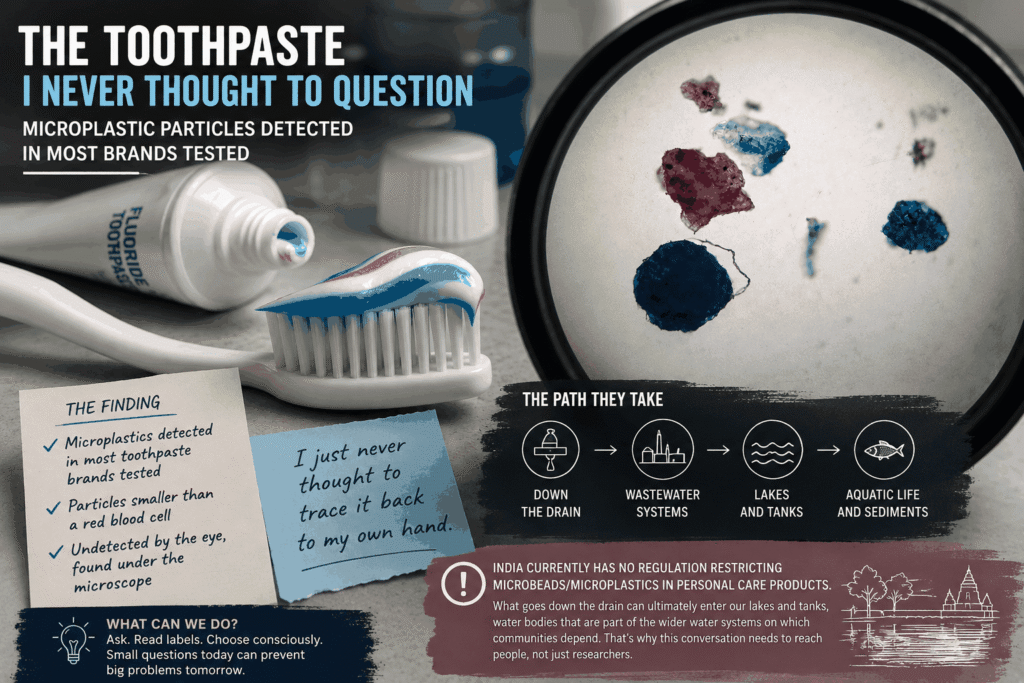
We tested several toothpaste brands sold across India, using a method sensitive enough to detect particles the eye could never see. What came back surprised even me: microplastic particles were detected in most of the brands we tested, some smaller than a single red blood cell.
Small does not mean absent. It may simply mean we have never looked closely enough to notice.
Microplastics have been used in some personal care products, including toothpaste, in the form of tiny plastic particles known as microbeads. In toothpaste, these particles can serve as mild abrasives, helping scrub away surface stains and polish the enamel. What is easy to overlook is that what helps clean our teeth can also enter the environment when we rinse and spit.
The part that stayed with me longer than the numbers did was what happens after we spit the toothpaste out.
It goes down the drain and into wastewater systems designed to handle many kinds of waste, but where particles this small can be difficult to remove completely. From there, they can enter the environment, including the same lakes and tanks I have spent my career studying. Aquatic organisms can take them in, and particles can accumulate in sediments.
One more thing is worth flagging: India currently has no specific regulation restricting microbeads or microplastics in personal care products. What goes down the drain can ultimately enter our lakes and tanks, including water bodies that are part of the wider water systems on which communities depend. That is why this conversation needs to reach people, not just researchers.
I had traced plastic through Madurai’s water for years. I just never thought to trace it back to my own hand.
I am not writing this to scare anyone away from toothpaste. This is not that kind of story. But it is a small warning worth sitting with: the things we assume are too ordinary or too small to matter are often exactly the things nobody has checked closely enough.
We trust the label. We assume that if something were really wrong, someone would have said so already. Often, no one has – not necessarily because it is not worth checking, but because it is so easy to stop noticing the things we use every single day.
I have spent years studying what happens when nobody stops to ask these questions in time. It would be easy to feel that the damage is already done – that water, fish and sediment have absorbed more than we can undo.
Some days I feel that. But I do not think it is ever too late to start paying attention. It is simply later than it would have been if we had started sooner.
So here is what I would ask of you, the same thing I have had to ask of myself: pick one thing today – one product, one habit, one purchase you have stopped questioning – and look a little closer.
You do not have to overhaul your life overnight. You do not have to fix everything, perfectly or immediately. You simply have to be willing to take the next small step, whatever that looks like for you.
Because that is really how change happens. Not in one big decision, but in someone deciding – today, and then again tomorrow – that it is worth trying anyway.
It is never too late to start.