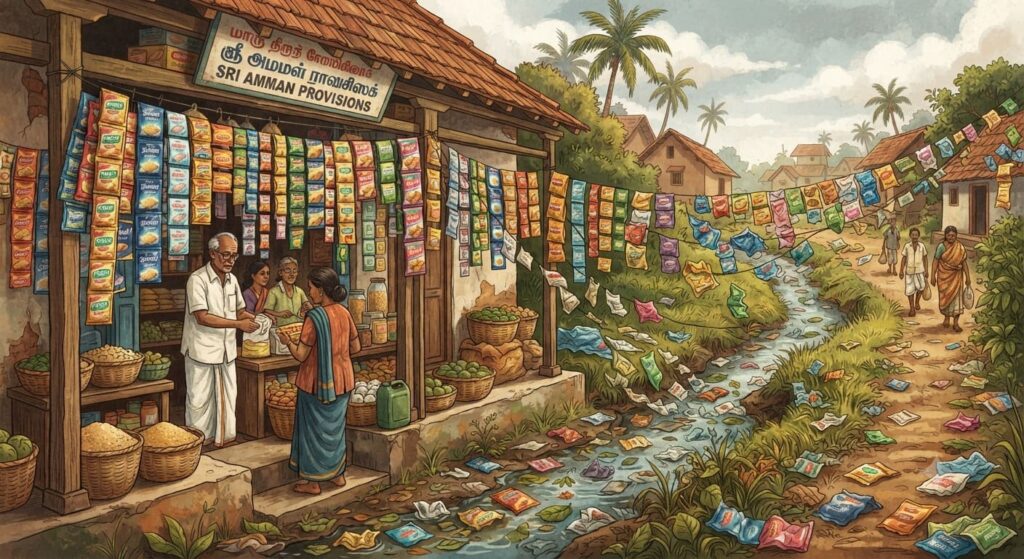
As a young girl, a trip to the grocer was an exciting affair. There was one shop, and you simply told the shopkeeper what you needed, and he packed it for you from large sacks kept behind the counter: rice, lentils, sugar, tea, measured out exactly as much as your household could use. As time went by, I watched that same shop change in front of me. A small rod went up at the front, strung with little hanging packets, sachets, we call them now. The big glass bottles that had always lined his shelves began to disappear, replaced one by one with plastic.
We rarely see shops like that anymore. We are surrounded by supermarkets now, aisles of choice, and no shortage of advertising and brand power nudging us toward one packet over another. What none of us stopped to ask, as the shelves filled with smaller and smaller packaging, was what we were actually generating along with every purchase.
A Tamil Invention that Went Global
The sachet, as it happens, was born not far from where I grew up. In 1983, K. P. Ranganathan, the founder of the company CavinKare, launched Chik shampoo in sachets priced at under a rupee, built specifically for rural South Indian households who couldn’t afford a full bottle. It worked extraordinarily well, so well that the industry itself came to call it the “sachet revolution.” By 2004, sachets made up 90 per cent of shampoo sales in rural India and 70 per cent in cities. By 2021, India was selling roughly 41 billion shampoo packages a year, and 99 per cent of them were sachets. What began as a clever, generous idea, bringing a product within reach of people who had been priced out of it, has since metastasised, as one account of the industry puts it, far beyond shampoo into everything from ketchup to coffee to detergent.
Cheaper, But Does It Save You Anything?
Here is the question I keep returning to, the one I think most of us never pause to ask at the checkout counter: does the sachet actually give us our money’s worth? Research into shampoo pricing in India found sachets can run up to 50 per cent cheaper per millilitre than the equivalent bottle. On paper, that looks like a straightforward win for the buyer. But a bottle lets you pour out exactly as much as you need for one wash. A sachet, by its very design, tends to get used in full, whether or not that wash actually needed ten millilitres. The saving on paper quietly erodes in practice, and what looks like thrift becomes, more often than not, overuse dressed up as economy. It is, as the industry itself understood from the very beginning, a far more profitable way to sell the same product, not necessarily a more economical way to buy it.
Where It All Goes
And then there is the part of the sachet’s story that never appears on the packet. Once you have used it, the sachet does not simply disappear. A multi-layered packet, usually part plastic, part foil, has essentially no scrap value, which means the informal waste economy that keeps so much of our plastic circulating, the ragpickers and recyclers who make their living sorting and selling what the rest of us throw away, has no reason to collect it. Globally, researchers estimate the sachet economy puts around 855 billion of these packets into the world’s poorest waste systems every year, and that only about a third of them are properly processed in any way at all. In India specifically, an estimated 85 per cent of all plastic waste generated ends up simply littered, not landfilled, not recycled, not burned in any controlled way, just left wherever it was last used.
The Month We Never Look Back On
I notice my own part in this every month. During the first week, like so many households, I shop for a month’s worth of groceries at once, and when I get home, I decant much of it into glass or steel containers for the kitchen. It is a satisfying, tidy ritual, filling jars, lining up bottles. What I rarely do, in that same ritual, is turn around and actually look at the pile of emptied plastic sitting beside me: the wrappers, the sachets, the packets that brought all of it home. We go on picnics and bathe in waterfalls, and the sachet of shampoo or the empty chip packet gets left behind in the grass or the stream, not out of malice, simply out of habit, the same habit that has let an entire industry grow around the assumption that we will not ask where any of it goes.
Worth Pausing Over
I don’t think the answer is to mourn the loss of that one-shop, measured-out childhood, charming as it was in memory. The sachet did something genuinely useful once: it put shampoo, soap, and seasoning within reach of people who had been shut out of the market entirely. But usefulness and consequence are not the same thing, and we have let the first quietly excuse us from thinking about the second. The next time you reach for the small packet instead of the bottle, because the convenience aisle has made that the default, it might be worth a single pause: not to feel guilty about it, but simply to ask where, exactly, that small piece of plastic is going once your hands are done with it. We built this habit without noticing. We can, at the very least, notice it now.
(Marie Serena McConnell is an Assistant Professor in the Department of Zoology and Research Center at Lady Doak College, Madurai.)