During the COVID triggered lockdown, widespread panic swept across many families. The government issued SOPs, but we, the masses, rarely took notice of them. Wear a mask, we were told. Did we care? Not really. Not until it hit our own families. I sadly lost four family members and many friends to the pandemic. And what did we do in response? We sat in our cosy homes and passed on unverified messages on WhatsApp and social media.
That single sentence still unsettles me when I think back on it. We had lost people. We had every reason to want the truth. And instead, our collective response was to forward.
A Trend That Hasn’t Gone Anywhere:
This has become a common pattern I now see in my own students. They watch a reel, don’t verify the scientific claim in it — even though we are scientists, trained to ask for evidence — and repost it anyway, making it go viral within minutes. Later, when we discuss the same topic in class and I point out the actual science, they rethink their stand entirely. The information to correct them was never far away. They simply never paused long enough to look for it before hitting share.
Instagram and social media abound with posts on diet fads, what should or shouldn’t be part of our meals, which foods are secretly “toxic” and which are miracle cures. We watch, we repost, and we forget — never once allowing our brains to actually digest and process the information, let alone verify it.
What Ants Do Without Thinking:
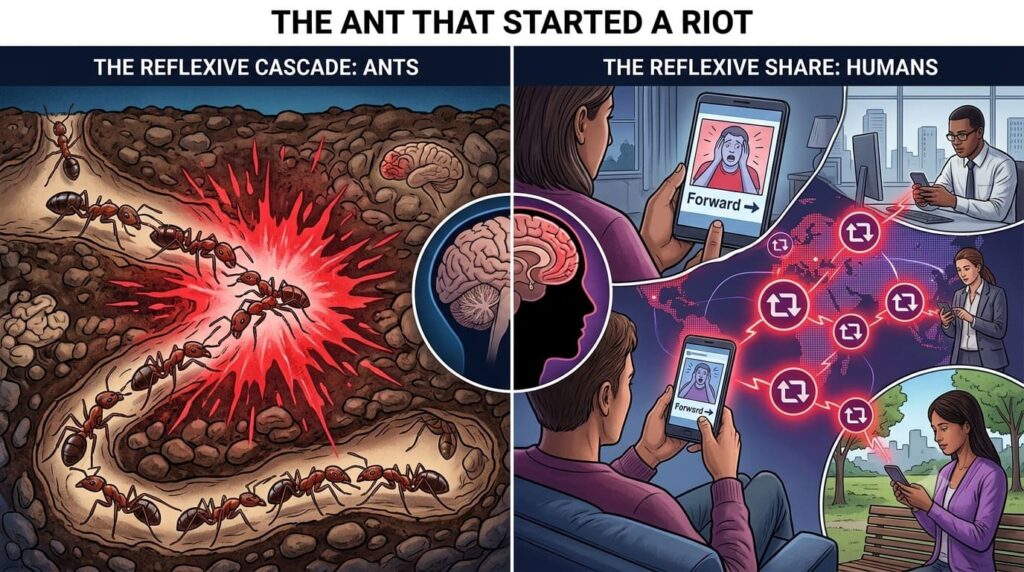
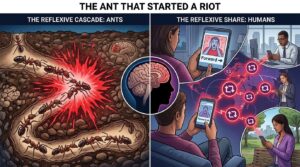
As an entomologist, I recently read a study that, oddly enough, put language to exactly what I’d been observing in my students and in myself. Researchers studying ant colonies — species like Temnothorax rudis — modelled how colonies produce something called activity bursts: sudden, sharp spikes where a large portion of the colony starts moving almost simultaneously, followed by long stretches of stillness. For three decades, scientists knew these bursts happened but not quite how.
What the researchers found was this: it only takes a single ant — what they call the “first mover” — to spark the entire cascade. That one ant becomes active, brushes past a neighbour, and that neighbour activates too. Within a handful of these contacts, the researchers found the wave of activity has already spread through most of the colony, faster than any individual ant is even moving through the nest. There is no deliberation in this. No ant “decides” the activity is warranted, checks a fact, or asks a follow-up question. It’s a purely contagious process — the very word the researchers use, drawing an explicit comparison to how diseases spread through a population, or how a chemical reaction catalyses itself once a single molecule sets it off. One ant near another is enough. The information — if you can call it that — doesn’t need to be good. It just needs to make contact.
We Are Not Ants, But We Are Behaving Like Them:
Here’s the part that stayed with me. Ants have no other option. They don’t have a prefrontal cortex weighing evidence, no capacity to pause and ask, “Is this true?” A first mover activates, and the rest of the colony has evolved, over millions of years, to respond near-instantaneously — because for an ant colony, speed of response can mean survival.
We are not ants. We have exactly the tool an ant colony lacks: the ability to stop, evaluate, and decide not to pass something along. And yet, during a pandemic that was killing people we loved, we behaved almost identically to a colony mid-burst. Someone forwarded a message. We received it, and forwarded it again, without so much as a contact’s worth of hesitation. The panic spread not because the information was good, but because contact was enough — exactly as it is for an ant.
The tragedy isn’t that we’re capable of this kind of reflexive cascade. It’s that we have every biological advantage over an ant colony in resisting it, and we choose not to use it.
Teaching the Pause:
I teach a course on science communication, and one of the first things I try to instil in my students is this: as students of science, spreading the correct information isn’t optional, it’s a responsibility. Every one of them has, at some point, been the unwitting “first mover” for a piece of misinformation that reached hundreds of people before a single person checked it. And every one of them, when we sit down and go through the actual evidence together, changes their mind. The correction was never hard to find. It just required someone to stop being a relay and start being a filter.
An ant colony synchronizes because no individual ant is expected to think. We are not so lucky, or perhaps we are luckier than we behave. The next time something arrives on our phones designed to spread — a health claim, a cure, a rumour dressed up as fact — the choice in front of us is a strangely simple one: be the first mover in a cascade of panic, or be the ant that, for once, decides to stay still.
(Marie Serena McConnell is an Assistant Professor in the Department of Zoology and Research Center at Lady Doak College, Madurai.)