I grew up in a house that was mad about pets. Dogs, cats, fish – if it breathed, we probably brought it home. At one point we had up to ten dogs at a time. I loved every single one of them, the mongrels and the mutts most of all, the ones nobody would look twice at outside our gate. Today I live in an apartment in the middle of a busy life, and I miss them terribly – the noise, the chaos, the sheer unconditional devotion of a house full of dogs.
My brother, meanwhile, has a farm, and on it, a Bully Kutta – a fierce, loyal, unmistakably Indian breed built for guarding land, not lounging on a couch. He didn’t pay a premium for prestige. He got a dog built for exactly the life he lives.
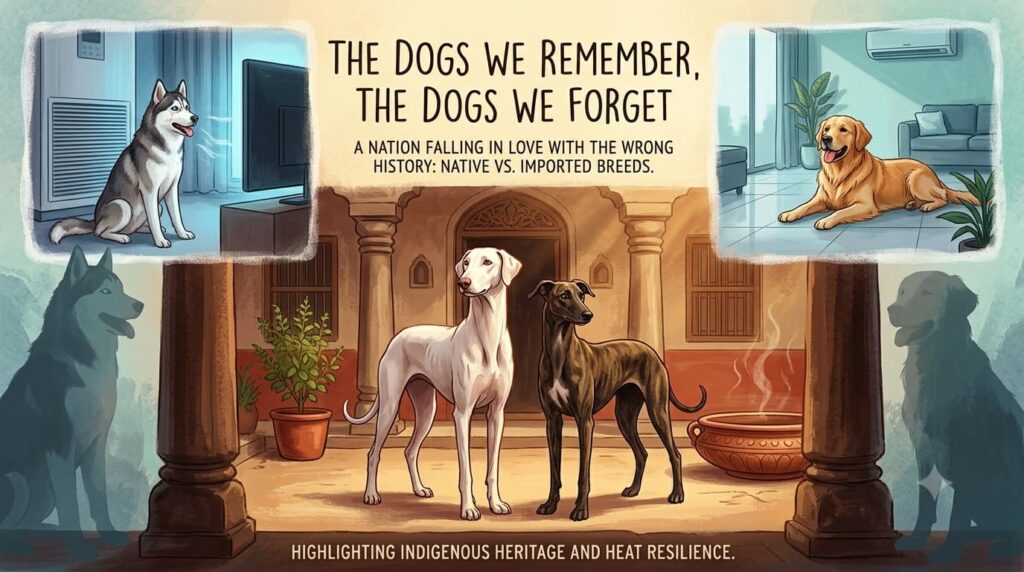
Around me, though, I keep noticing something else. Friends, family, colleagues – all buying puppies at prices that would have seemed absurd to my childhood self. A pup for ₹25,000!!! Labradors, Golden Retrievers, Pugs and Huskies everywhere, in every apartment complex, on every evening walk. Beautiful dogs, no doubt. But dogs bred for cold, spacious, temperate countries thousands of kilometres from Madurai, now panting through our summers in third-floor flats.
A Nation Falling in Love with the Wrong History
We are, undeniably, becoming a nation of pet lovers. A study I co-authored surveying over a thousand people across Tamil Nadu found that 51% now own pets, and dogs are the clear favourite – chosen by 46% of pet owners, ahead of fish, birds, and cats combined. India’s pet population has grown from roughly 13 million households in 2014 to 18 million in 2018, and it hasn’t slowed since.
But here’s the part that stayed with me long after the data was tabulated: 75% of the people we surveyed said they were aware that India has its own indigenous dog breeds. And yet, when shown photographs, they could barely recognise them. The Rajapalayam, a breed as old as Tamil Nadu itself, was correctly identified by only 15% of people. The Chippiparai – a hunting dog that has run alongside Tamil families for centuries – by just 12%. Compare that to the German Shepherd, recognised by 18% at a glance despite belonging to none of our histories, our climates, or our courtyards.
We know these dogs exist. We have simply stopped being able to see them.
A Pedigree Problem
Part of the issue is that our own systems don’t take our own dogs seriously. Indigenous breeds like the Rajapalayam, Chippiparai, and Mudhol Hound are still not accepted as pedigreed breeds within India, let alone recognised internationally. The American Kennel Club lists 202 breeds – not one of them Indian. The Indian Council of Agricultural Research (ICAR) only began registering indigenous dog breeds in 2012, and even now, only four have made it onto that list.
There are no formal breed standards. No traceable pedigrees beyond a few generations. Few genomic studies to establish what makes a Chippiparai a Chippiparai, or a Kombai a Kombai. Meanwhile, breeders freely market puppies as “pure Labrador” or “pure Golden Retriever,” charging premiums for imported bloodlines while our own native breeds – dogs perfectly adapted to Indian heat, Indian diseases, and Indian households – go undocumented and unclaimed.
The Dog That Outgrows the Apartment
There’s a quieter tragedy tucked inside all this enthusiasm for pet ownership, and it’s one the data doesn’t fully capture but that anyone who has lived here long enough has seen firsthand: the dog that gets bought as an adorable puppy, and abandoned the moment it becomes an adult.
A Labrador puppy is irresistible. A fully grown Labrador needs space, exercise, and a household prepared for its size and energy – things an apartment bought for convenience, not for a dog’s future, rarely accounts for. A Husky brought home because it looked stunning in a reel is, within a year, a heat-stressed, shedding, deeply unhappy animal in a city nine degrees north of the equator. When the cuteness fades and the reality of upkeep sets in, too many of these dogs end up on the street, in shelters, or simply “given away” – not because they did anything wrong, but because no one thought past the puppy stage.
Indigenous breeds, ironically, are often hardier and better suited to exactly this – our heat, our food, our diseases, our unpredictability. But they don’t have the Instagram appeal of a Retriever puppy or the status of an imported breed with a six-figure price tag. So they stay in villages, on farms, guarding gates like Luna, my brother’s Bully Kutta – appreciated by those who know them, invisible to almost everyone else.
What We Choose to Save
India has taken up the cause of indigenous cattle breeds with real seriousness – Kangayam cattle, for instance, are protected partly through their connection to traditions like jallikattu. Our dogs have no such champion. And yet they carry the same weight of history: references to Indian hounds appear in the Rig Veda, in the Ramayana, in accounts by Pliny the Elder and Herodotus describing dogs so prized that Persian kings maintained entire villages to breed them.
We have not run out of reasons to protect these breeds. We have simply run out of attention for them.
So, the question I keep returning to – the one I’d ask anyone standing in a pet shop, credit card in hand – isn’t whether to bring a dog home. It’s whether we’re choosing a dog for who we are, where we live, and what we’re actually prepared for – or whether we’re choosing a trend that will outgrow both the apartment and our patience. My brother’s Bully Kutta didn’t need an air-conditioned room or an imported diet to thrive. It needed exactly what it was built for. Perhaps that’s the kind of match we owe every dog we bring into our homes – indigenous or otherwise.
(Marie Serena McConnell is an Assistant Professor in the Department of Zoology and Research Center at Lady Doak College, Madurai.)























This Post Has One Comment
Fact, absolute Fact. I also had a Labrador didn’t have a Native dog. Nice stats as well.
As said the dogs which are abandoned after a period of time is on a rise