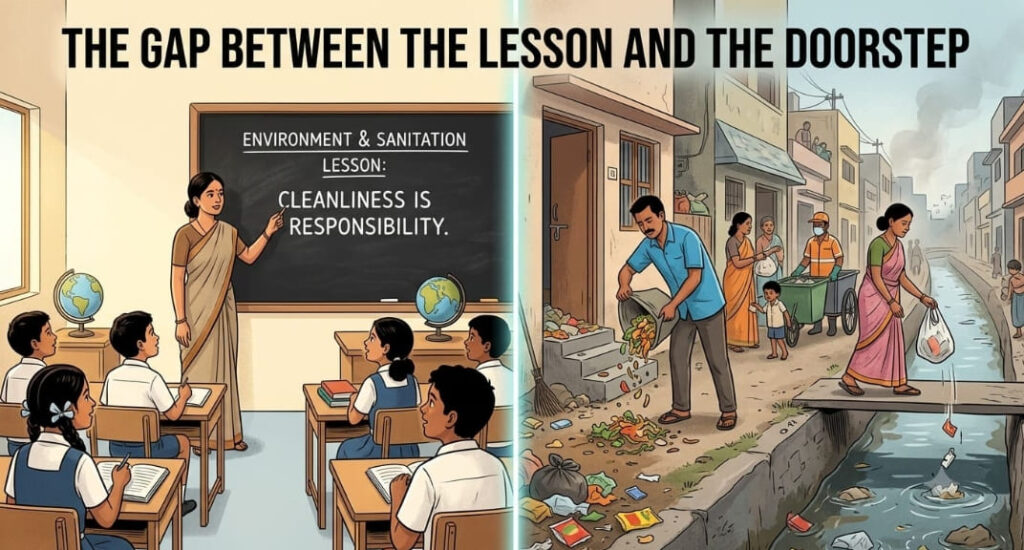
The Gap Between the Lesson and the Doorstep
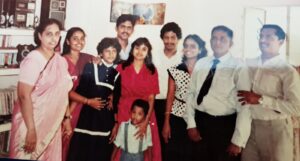
Growing up in an affluent residential area of Tiruchirappalli, our house sat at the far end of the road. We were surrounded by neighbours of every faith, and so we ended up celebrating almost all the festivals – Diwali with one family, Eid with another, Christmas with a third. But no matter how many degrees hung on a person’s wall, a few behaviours were impossible to miss. The households that celebrated Diwali would burst crackers deep into the night, and by morning, without fail, all the dust and debris would be swept off their doorstep – and onto ours. This happened every single year.
It is a small thing, but it captures something universal: I cleaned my home. My home is clean. I don’t care where the dust goes. It created its own quiet, recurring squabbles among the maids who had to deal with the aftermath. And it never really stopped being funny to me, in a sad sort of way, that some of the most highly educated people I knew practiced this without a flicker of self-awareness.
The Same Story, A Different City:
Years later, in Madurai, I see the grown-up, industrial-scale version of the same instinct. People carrying rubbish in bags – not to a bin, but to an empty plot down the road. People standing on bridges, tipping garbage straight into the river below. Not out of malice. Just out of the same old logic: once it leaves my hands, it isn’t my problem anymore.
We were all taught better than this. Every one of us sang the same rhymes in school about picking up litter and putting rubbish where it belongs – “bits of paper, lying on the ground” and all its cousins, sung with genuine enthusiasm in assembly halls across the country. We learned about the water cycle, about pollution, about the ozone layer, about caring for the environment, in classroom after classroom, year after year. And yet somewhere between the classroom and adult life, all of it stayed exactly where it was: in the classroom.
What the Numbers Actually Say:
It isn’t just anecdote. In the most recent Swachh Survekshan – India’s national annual cleanliness survey conducted by the Ministry of Housing and Urban Affairs – Madurai was ranked the dirtiest city in the country among those with a population above ten lakh, scoring just 4,823 out of a possible 12,500. The city actually scored full marks on cleanliness in its markets, water bodies, and residential zones on paper. Where it collapsed was everywhere the average resident and the average system quietly let go of responsibility: only 4% on waste processing relative to what’s generated, 37% on door-to-door collection, 26% on source segregation at home, and a mere 3% on public toilet cleanliness.
Read those numbers carefully and they stop being abstract. Source segregation at home is not a government infrastructure problem – it is a two-bin problem, in every kitchen, that most of us have simply decided isn’t worth the extra ten seconds. Door-to-door collection failing at scale is often a story of individuals who don’t wait for the collection, who find it faster to walk to the empty plot at the end of the street instead.
Blaming the Government, Ignoring the Mirror:
Whenever these rankings come out, the response is nearly automatic: blame the government, blame the corporation, blame the sanitation workers for not doing their jobs. Rarely do we ask what we did with our own waste yesterday, or the day before, or ask why a bag of it ended up in a canal instead of a bin.
Sanitation workers are treated as the problem rather than the people absorbing the cost of everyone else’s choices. Theirs is one of the most physically demanding, least protected, and most thankless jobs in any Indian city – and it is also one that is only ever noticed when it isn’t done. Nobody applauds a clean street. Everybody complains about a dirty one, usually while stepping over a bag they didn’t bother to carry ten more metres to a bin.
Closing the Gap:
Solid waste management in Madurai, and in a hundred cities like it, would look dramatically different if the education most of us received actually made the short journey from memory to muscle. Not new laws. Not new technology. Just the same lesson, finally practiced: carry your own rubbish a little further, segregate it before it leaves your hands, stop treating a riverbank or an empty plot as somebody else’s problem to inherit.
We don’t have a knowledge gap. Every child who has ever sung that rhyme about litter knows exactly what they’re supposed to do. What we have is a distance – between what we were taught and what we’re willing to actually live by. And that distance, unlike a landfill, costs us nothing to close.
(Marie Serena McConnell is an Assistant Professor in the Department of Zoology and Research Center at Lady Doak College, Madurai.)