I grew up in a colonial bungalow surrounded by gardens. My grandfather was and my mother still is, avid gardeners – the kind who know every plant on the property by name. I, unfortunately, am allergic to insects (an ironically an entomologist), and so I didn’t venture into the gardens themselves. But I spent many an hour sitting by the door, enjoying the cool breeze, eating mangoes straight off our tree, watching the green world from just outside its edge. My mother had a tradition of making us stand at the gate at the start of every school year for a photograph – the same spot, the same garden behind us, year after year, marking time the way only a living, growing thing can.
When My Brother Left the Corporate World for a Hill
In later years, my brother, who had built a career in corporate jobs, left it all behind. He eventually found land at the base of a small hill, reachable only by a narrow panchayat road, bordering a reserve forest. He bought it, and has spent the last few years turning it into a working farm – goats, indigenous chickens, fruit trees, organic vegetables grown for the family table rather than for a market shelf.
He isn’t alone in this. It’s become something of a quiet trend: capable, well-employed young people stepping away from corporate careers and returning to the land, not out of necessity but out of choice. And when I look at the growing body of research on what gardening and growing actually do to a human mind, I find myself less surprised by this trend and more convinced it’s simply science catching up with something my brother already knew in his gut.
What Actually Happens When You Put Your Hands in Soil
A recent paper examining the health benefits of home gardens lays out the case in more biological detail than I expected. Gardening, it turns out, isn’t just a pleasant pastime – it reconnects us with soil microbiota in ways that appear to support immune function and even help regulate our endocrine system, alongside the more familiar psychological benefits: greater mindfulness, more stable emotional states, sharper cognitive function, and real reductions in stress, anxiety, and depression. The researchers go so far as to argue that our care for a garden reciprocates back onto our own health – that tending something living is, quite literally, a two-way exchange.
What struck me most, though, is how quickly these effects show up. A study on horticultural therapy with college students measured mood, facial expression, and even salivary cortisol – the body’s primary stress hormone – before and after single gardening sessions. The improvement wasn’t something that built up slowly over weeks. It showed up after just one session, measurable in the bloodstream. You don’t need years of dedicated gardening to feel a difference. You need about an hour and a few plants.
You Don’t Need My Brother’s Hill
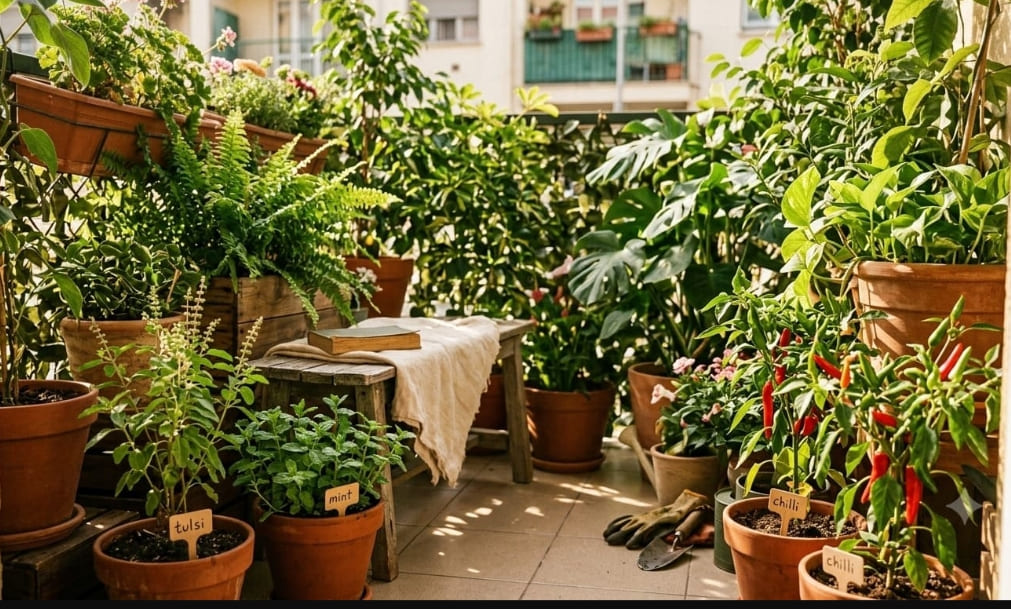
Here’s where I want to gently push back on the idea that this is only available to people with land, a farm, or a hillside bordering a forest. A recent systematic review looking specifically at biophilic interventions – plants, light, and natural elements – in confined indoor settings pulled together findings from over a hundred studies, and the conclusion was consistent: even small, contained doses of greenery in cramped, urban environments produce real, measurable wellbeing benefits. Your balcony counts. Your windowsill counts. A single pot of curry leaves or mint on a kitchen ledge in a third-floor apartment counts.
And it isn’t just a one-off boost. A study of urban residents in a rapidly developing city found that the more frequently people gardened, the more attached they became to the activity itself – and that attachment, in turn, predicted meaningfully better mental wellbeing and lower stress, compared to residents who didn’t garden at all. In other words, gardening rewards you for staying with it. The relationship deepens the longer you tend it, much like any relationship worth having.
A Small Challenge
So here is what I want to leave you with, whatever your circumstances. If you have a garden, actually spend time in it – don’t just walk past it on your way to the car. If you have a balcony, put one pot on it this week: curry leaf, tulsi, a chilli plant, anything that will tolerate your particular light and neglect. If you have neither, a single windowsill and a jam jar of mint cuttings will do more for you than you’d expect.
You don’t need my brother’s hill, his goats, or his view of the reserve forest to get something real out of this. You need something small, something alive, and the willingness to notice it grow. Evolution gave us bodies that respond, chemically and immediately, to the presence of green things around us. The least we can do is give it something to respond to.
(Marie Serena McConnell is an Assistant Professor in the Department of Zoology and Research Center at Lady Doak College, Madurai.)