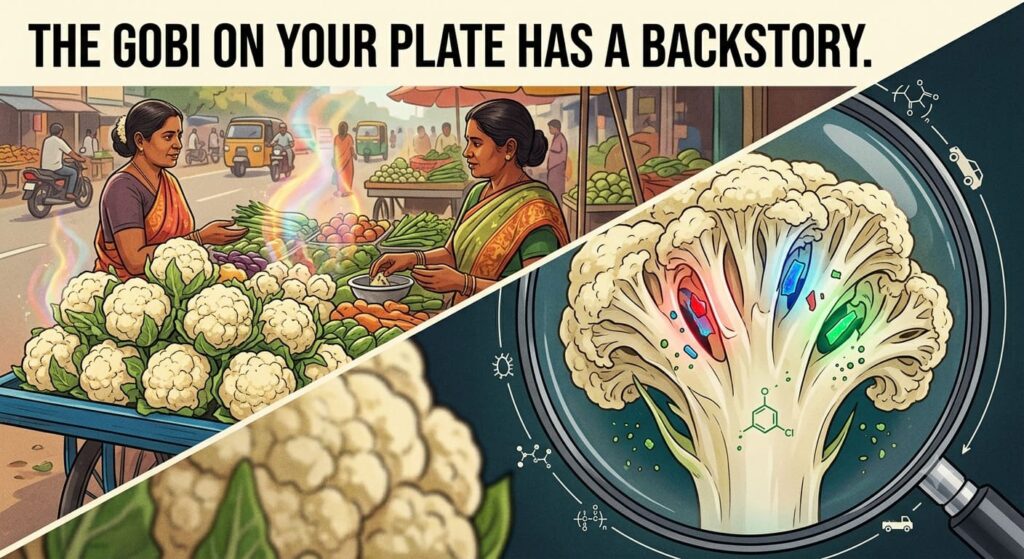
Growing up, we always went to the local market on Sundays to buy for the week, or a lady would bring her pushcart to our doorstep, selling vegetables fresh off the load. As my mother grew older, she came to prefer the lady with the pushcart – less crowd, more trust, the same familiar hands weighing out the beans and greens every week. Across Asia, these open markets remain a source of fresh produce and easily accessible protein for millions of us. But do we ever stop to think about how much pollution is already sitting inside that produce before it even reaches our kitchen?
A Silence That Has Lasted Decades
We have to assume, after decades of pesticide use, that nothing sold to us is truly “organic” anymore – not because farmers are being careless, but because pesticide residues simply don’t disappear. They persist in soil and water, degrading slowly over years, sometimes decades, quietly working their way back into whatever we grow in that same ground. Studies on Indian cauliflower alone have repeatedly found measurable pesticide residues – organophosphates, organochlorines, synthetic pyrethroids – turning up in market samples from Punjab to Gurugram to Karnataka. In one Bangladesh-based study, chlorpyrifos, a common pesticide, was detected in 44% of cauliflower samples tested, with the majority exceeding safety limits. This isn’t a fringe finding. It’s the quiet, unglamorous baseline of what “fresh vegetables” have come to mean in South Asia.
And now, sitting alongside the pesticides, we have a newer, less understood contaminant: microplastics. They have become ubiquitous in nature – in soil, in air, and, as it turns out, in our food.
What We Found in Our Own Backyard
In a recent study, my student and I examined cauliflowers sold in the open-air markets of Madurai, and what we found genuinely surprised us. Every single market sample we tested contained microplastics – none of the supermarket cauliflowers we used for comparison did. The reason, we think, comes down to something almost architectural: the tightly packed, folded structure of a cauliflower’s florets is extraordinarily good at trapping airborne particles. Dust from the road, rubber worn off passing tyres, fragments of packaging blown loose in the wind – all of it settles into those folds and stays there, since cauliflower is typically sold unpackaged, unwashed, and fully exposed to the street.
Using infrared spectroscopy, we identified several different types of plastic in these samples – polystyrene, polypropylene, and materials associated with packaging and vehicle components, among others. The market closest to the busiest traffic corridor showed the highest contamination. It didn’t feel like a coincidence.
A Vegetable That’s Everywhere
Here’s the part that makes this personal rather than academic: cauliflower is part of nearly every household’s diet in India. There is hardly a restaurant that doesn’t serve Gobi Manchurian or Gobi 65. I love it too – genuinely, unapologetically. But loving something doesn’t mean we shouldn’t ask what, exactly, is going into our gut along with it.
I am not claiming a plate of Gobi 65 is going to make anyone sick tomorrow. That’s not what this is about. What concerns me is the slow, cumulative exposure – small doses of pesticide residue and microplastic particles, meal after meal, year after year. There is growing evidence that this kind of chronic, low-level exposure can alter gut bacteria, and gut bacteria, we now know, quietly shape far more of our health and mood than we once gave them credit for. It isn’t dramatic. It’s slow. And slow is exactly the kind of danger that’s easy to ignore.
Nobody Told the Vendor Either
Perhaps the most sobering part of our study wasn’t the contamination itself – it was speaking to the vendors who sell this cauliflower every single day. The overwhelming majority had never heard of microplastics at all. Not because they don’t care about the food they sell, but because nobody has ever told them there was anything to know. They are, in every sense, the final human checkpoint between a contaminated vegetable and a family’s dinner table – and they’ve been left completely out of the conversation about what that vegetable might be carrying.
Not a Reason to Give Up Gobi
I want to be very clear about what I am not saying. I am not asking anyone to give up cauliflower, or to panic about their next plate of Gobi Manchurian. What I am asking is that we stop treating pollution as a textbook chapter – something that happens in “the environment,” out there, separate from us – and start recognising it as something already sitting in the folds of the vegetable on our cutting board.
Pollution isn’t a distant, abstract threat anymore. It’s in the soil that grew your dinner, the air your vegetable sat in at the market stall, and quite possibly, in the very structure of the cauliflower floret you’re about to fry. That doesn’t call for despair. It calls for a little more attention – washing produce more deliberately, asking questions about where and how it was sold, and pushing, as a society, for vendors and markets to be given the same awareness we expect scientists to have. The problem was never that the science didn’t exist. It’s that it never made it past the lab and into the marketplace, where it actually matters.
(Marie Serena McConnell is an Assistant Professor in the Department of Zoology and Research Center at Lady Doak College, Madurai.)