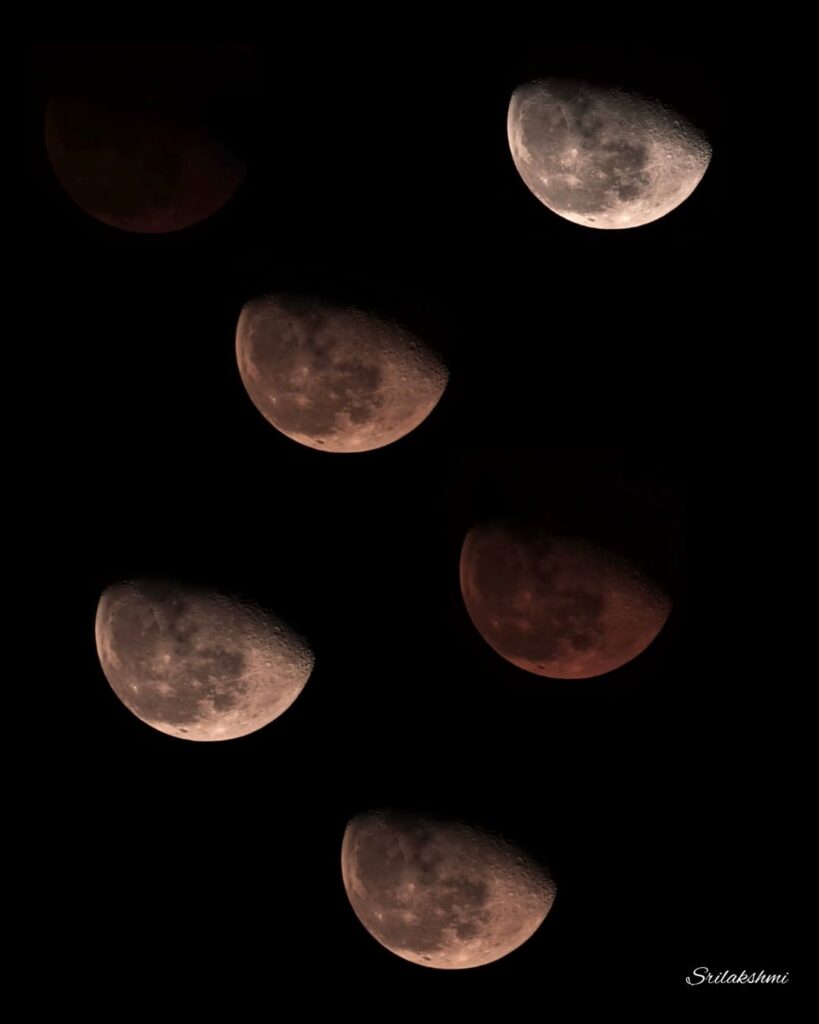
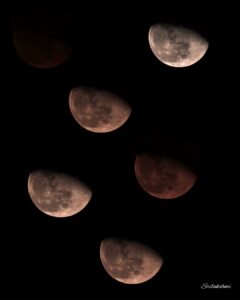
The different shades of Moon between 10:15PM – 11:00 PM on the night of 01st October. Image captured using Seestar telescope.
Why does the Moon appear in different shades?
To start with, the Moon does not have light of its own. It reflects light from the Sun, and sunlight contains all the colours of the visible spectrum—from violet to red. 🌈 (In case you didn’t know, that is exactly why a rainbow is made up of rainbow colours 😊)
Our Moon can look remarkably different from one night to another. Sometimes it takes on beautiful shades of orange, red or even yellow, depending on where it is in the sky and the conditions of our atmosphere. It is to be noted that the Moon itself never changes colour – in fact it is a dusty grey world.
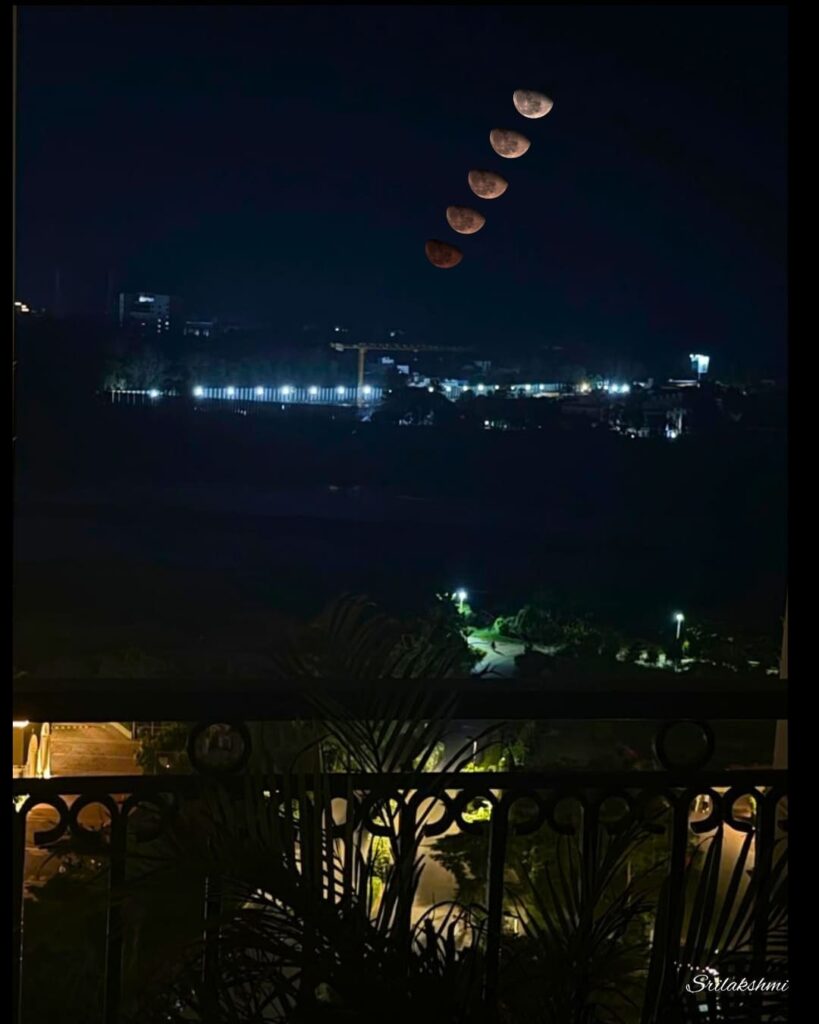
Then what could be causing the colour change? The answer is our atmosphere. As the Moon rises close to the horizon, its light has to travel through a much thicker layer of Earth’s atmosphere. The atmosphere scatters and absorbs more of the shorter blue wavelengths of light, allowing more of the red and orange light to reach our eyes. The result can be a Moon that looks surprisingly different from the familiar bright, silvery disk we usually see.
The Moon rising over the Bay of Bengal, imaged using iPhone 16 A composite image of the Moon rise using Canva.
However as the Moon climbs higher, its light travels through a much thinner slice of the atmosphere. Less scattering occurs, and the Moon returns to its familiar bright white or silvery-grey look.
It was a beautiful reminder that the Moon we see is always the same Moon—but our view of it can change dramatically.