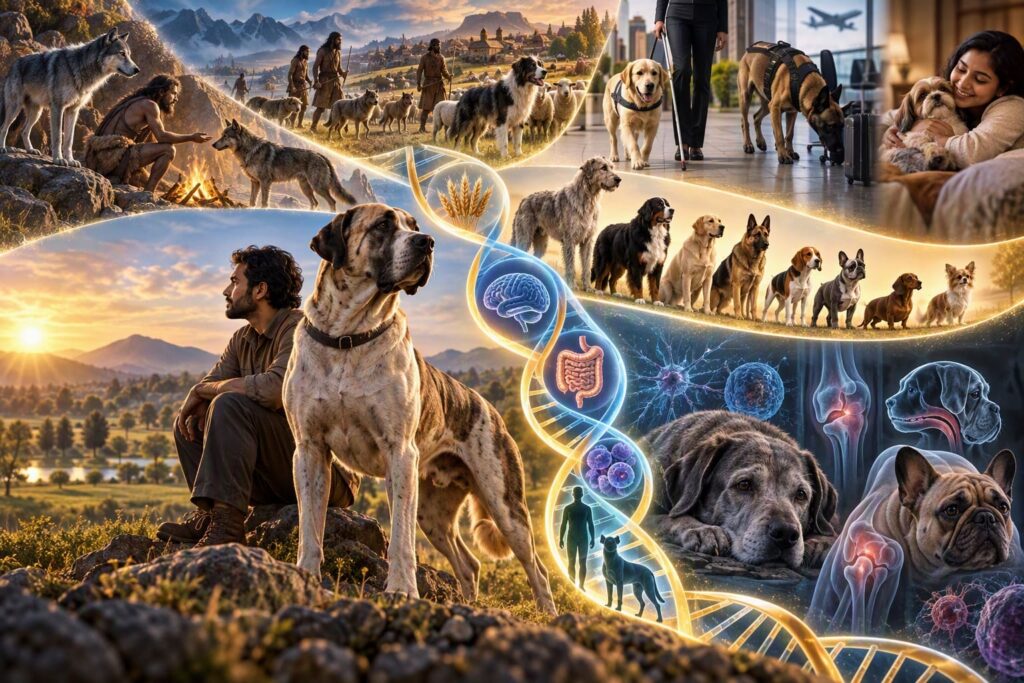
I’ve written about my brother’s dog Luna before. She’s a big, old, crazy hulk of a dog, belonging to a breed called the Bully Kutta – sadly, one that is bred almost exclusively for illegal fighting today. But back in the day, these were prized guardian dogs, known to take down leopards, fierce protectors at the core. Working dogs, through and through. As I sit here watching Luna patrol my brother’s farm, it’s hard not to see her as a small, living monument to one of the greatest, longest-running stories of evolution: how a wild animal looked at us, calculated the odds, and decided we were worth the gamble.
An 11,000-Year Migration, Side by Side:
We tend to imagine dog breeds as a modern invention – the product of the last two centuries of enthusiastic Victorian breeders with clipboards. But the partnership itself runs far deeper. A major genomic study published in Science this past November analysed dog genomes spanning nearly 10,000 years across Eastern Eurasia and found that as different human cultures moved, migrated, and traded – hunter-gatherers, early farmers, Bronze Age pastoralists – their dogs moved with them, generation after generation, their genetic ancestry tracking almost exactly alongside their humans’. Wherever people went, dogs went too, not as accessories to the journey but as active participants in it. Long before we had the language of “breeds,” dogs and humans were already co-authoring each other’s futures.
That partnership goes back further still. Whole-genome comparisons between grey wolves and Chinese indigenous dogs put the split between the two at around 32,000 years ago – considerably older than earlier estimates – with only a mild population bottleneck along the way. In other words: dogs didn’t wait around to be tamed. The current thinking is that they may have domesticated themselves, drifting in close to human camps as scavengers, tolerating our presence a little more with each generation, until “tolerating” became “belonging.”
Rewriting the Same Genes:
Here’s the part I find genuinely astonishing as a scientist: dogs and humans didn’t just share a timeline, they ended up sharing genetic solutions to the same problems. When researchers compared genes under positive selection in both species, they found a striking overlap – genes tied to digestion and metabolism, to neurological processes, and even to cancer, had been reshaped in strikingly similar ways in both lineages, evidence of the two species facing, and adapting to, the same pressures side by side.
The digestion story is the one I love telling my students. Wolves, like true carnivores, are well equipped with enzymes to digest protein. But as dogs settled into human households, eating what we ate – cooked, starchy scraps rather than raw prey – they evolved extra copies of genes for starch-digesting enzymes, something no wolf has needed or acquired. It’s the reason a dog today can happily sit through a plate of curd rice, something that would baffle its wild ancestor completely. We didn’t just change what dogs looked like. We changed what their bodies could metabolise, at the genetic level, because we shared our food with them long enough for it to matter.
Then there’s the sheer scale of physical variation human intervention has produced – all while keeping dogs a single, interbreeding species. Look at the range: Irish wolfhounds and Bernese Mountain dogs and the mastiff family, dogs built like small horses, standing beside a teacup Chihuahua that fits inside a handbag. An Irish Wolfhound and a Chihuahua can, in principle, still produce fertile offspring between them – an almost absurd amount of physical diversity contained within one species, entirely the product of what we selected for, generation after generation: guarding, herding, hunting, guiding, or simply fitting into an apartment.
From Apex Protector to Emotional Support:
And the story keeps moving. One of the traits that made dogs so domesticable in the first place was their remarkable capacity to adapt – and that adaptability hasn’t stopped. Dogs have gone from apex protectors like Luna to something almost unrecognisable to their ancestors: emotional support animals, curated companions, four-legged members of increasingly childless households. Across parts of Asia, reports show more women choosing pets over children, pouring resources into them the way earlier generations poured resources into raising kids – dog strollers now outselling baby strollers in some markets, entire industries built around pet shoes, designer clothing, birthday parties. Do dogs need any of this? Almost certainly not. Are we spoiling them to soothe something in ourselves – guilt, loneliness, a redirected instinct to nurture? That’s a harder question, and I don’t think there’s one honest answer for everybody.
A Shared Body, A Shared Decline:
But here’s where the story gets uncomfortable, and where I want to leave you sitting for a moment rather than rushing past. The same genomic closeness that makes dogs such a moving evolutionary companion also means they share our vulnerabilities. A large multi-omic study of aging beagles, published just this year, found that the molecular pathways dogs’ bodies follow as they age – inflammation, declining DNA repair, breakdown of collagen and connective tissue – closely mirror the same pathways in aging humans. Dogs get diabetes. They get kidney failure. They get cancers, cognitive decline, arthritis – conditions that, decades ago, we didn’t expect to be managing in our pets with the same seriousness we manage them in our parents.
Some of that is simply the cost of a shared evolutionary road, and of dogs living long enough now, thanks to our care, to develop the diseases of old age in the first place. But some of it is a cost we manufactured directly. The narrow gene pools behind giant breeds bring hip dysplasia and heart disease along with the size we wanted. The flattened faces we found appealing in certain breeds bring breathing difficulties along with the look. We didn’t just shape dogs into guardians and companions and lapdogs – in the same act of shaping, we sometimes built in the very conditions that will shorten or complicate their lives.
Is It Worth It?:
So I’ll ask the question I keep circling back to, the one I don’t think has a comfortable answer: is it worth it? We took a wild, self-sufficient predator and turned it, through 30,000 years of shared history and 200 years of deliberate breeding, into an animal that can guard a farm, guide the blind, sniff out cancer, or simply curl up on a lap and lower someone’s blood pressure – and in the same breath, into an animal that can inherit our worst chronic diseases and a body shape it can barely breathe or walk comfortably in.
I don’t have a tidy answer. Luna, muscled and fierce and utterly devoted to my brother’s farm, seems like proof that the partnership was worth every bit of it. A brachycephalic breed struggling for breath on a hot afternoon tells a very different story. Perhaps the honest answer is that it depends entirely on what, exactly, we asked evolution to build – and whether we were willing to live with the consequences of getting exactly what we wanted.
(Marie Serena McConnell is an Assistant Professor in the Department of Zoology and Research Center at Lady Doak College, Madurai.)