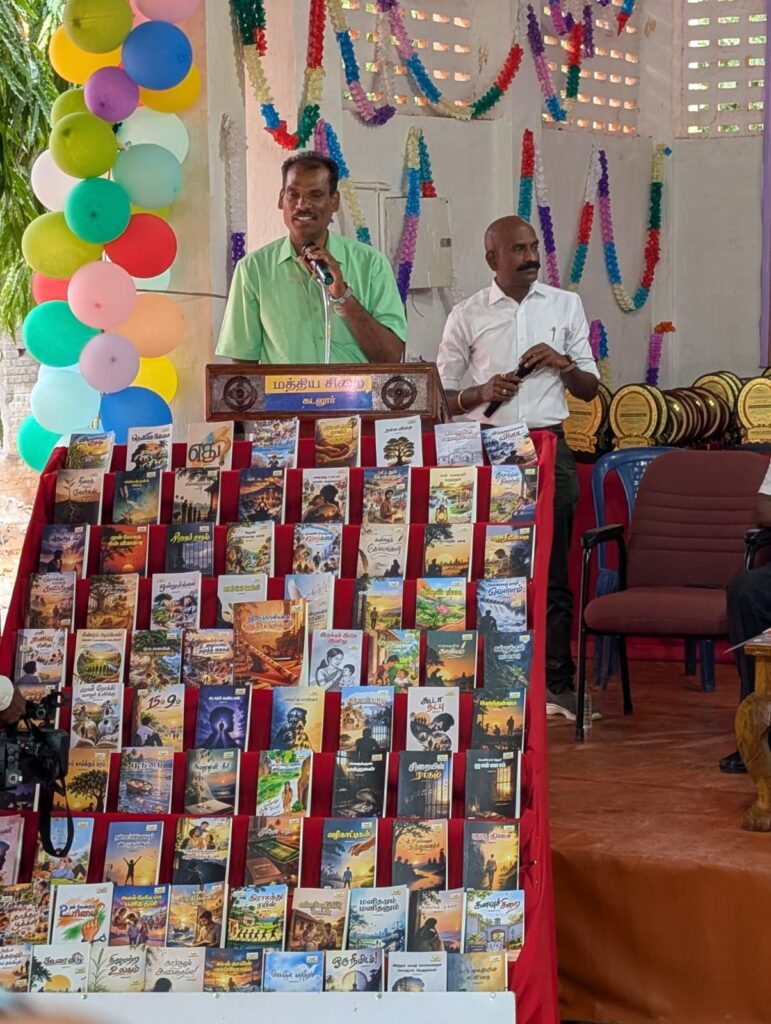
For two years, Marudhu (name changed) has lived behind prison walls, separated from his family and the life he once knew. But recently, he stood out for a different reason. Sporting a tie, he presented himself not merely as a convict, but as an author. He has written two books.
“We were like frogs in a well, but they asked us to swim in the ocean of dreams. This has opened up a new future for me. As a convict, I had put my family through pain and hardship. If this brings them a little joy, I am happy,” he says.
Marudhu is among 81 convicts lodged at the Cuddalore Central Prison who have turned authors, publishing 85 books spanning novels, short stories and poetry. Their achievement is the result of a conscious effort to introduce creative writing into prison life – an initiative that offers inmates something beyond the routine of incarceration: an opportunity to express themselves, rediscover their abilities and imagine a different future.
For Prakasam (name changed), another inmate who has found his voice through poetry, the experience has been transformative. “This exercise has refined this convict into a shining stone,” he says, describing how the initiative has helped him see himself differently.
When a convict becomes an author:
For people behind bars, writing can become a way to confront their past, articulate emotions and explore possibilities that once seemed out of reach. The Cuddalore initiative, undertaken by Ezhuthuga Iyakkam, or The Write Movement, has sought to create precisely that space.
The district administration, including the Collector, and the prison superintendent joined hands to make the effort possible. Coordinator Killivazhavan and his team worked tirelessly to encourage the inmates to write, helping them give shape to their thoughts and experiences.
The result is a collection of 85 published works – a milestone that gives the inmates an identity beyond their convictions.
The change is perhaps most visible in the families who have watched their loved ones take this unexpected step.
A wife’s pride, a family’s hope:
For Anjana (name changed), the news that her husband had written a novel brought a sense of pride that she had not anticipated.
“My husband has written a novel. I am so happy and proud to see my husband as an author. I pray he will be released soon and join us at home,” she says.
Her words capture the emotions of families who continue to live with the consequences of incarceration. The publication of a book does not erase the past or the pain caused by it. But it gives families something positive to celebrate – evidence that their loved ones can still learn, create and work towards a different future.
Suguna (name changed) is equally delighted by her husband’s achievement. His book focuses on farming and agriculture, a subject close to the lives of many families in Tamil Nadu. “My husband has written about farming and agriculture. I am happy,” she says.
For these women, the moment is about more than the books themselves. It is about seeing their husbands recognised for their creativity rather than defined solely by their status as prisoners.
A movement that began with children:
The Cuddalore initiative builds on an earlier experiment by The Write Movement, which encouraged children from disadvantaged communities in Chennai’s Kannagi Nagar to become authors.
That effort resulted in 50 books written by children, which were subsequently published and made available in the market. It demonstrated how access to encouragement, guidance and publishing opportunities could help people from less privileged backgrounds discover their potential.
Writer and former Chief Secretary Irai Anbu played a key role in these initiatives, helping take the idea of creative writing beyond conventional classrooms and into communities that are often denied such opportunities.
New Century Book House published the books, helping turn the participants’ writing into tangible achievements.
Killivazhavan and his team brought the same commitment to the prison project, encouraging inmates to channel their feelings and emotions into creative work.
The hope, Irai Anbu and the organisers believe, is that the initiative will encourage prisoners to reflect on their lives, recognise their abilities and work towards reform.
Education, expression and the road to reform:
Prisons in Tamil Nadu have seen inmates clear examinations and pursue higher education, including postgraduate and research degrees. Their achievements demonstrate that incarceration need not bring learning to a complete halt.
The emergence of 81 published authors from the Cuddalore Central Prison adds another dimension to that story.
Education can equip prisoners with qualifications and skills. Creative writing offers a different possibility: the chance to examine one’s experiences, communicate with others and discover a voice that may have remained unheard. This initiative offers a meaningful starting point – one that recognises prisoners as individuals capable of learning, reflection and creative expression.
And for the 81 inmates who now have books to their names, the pages they have written may represent the beginning of a new chapter – one in which their past remains part of their story, but does not have to be the only thing that defines them.