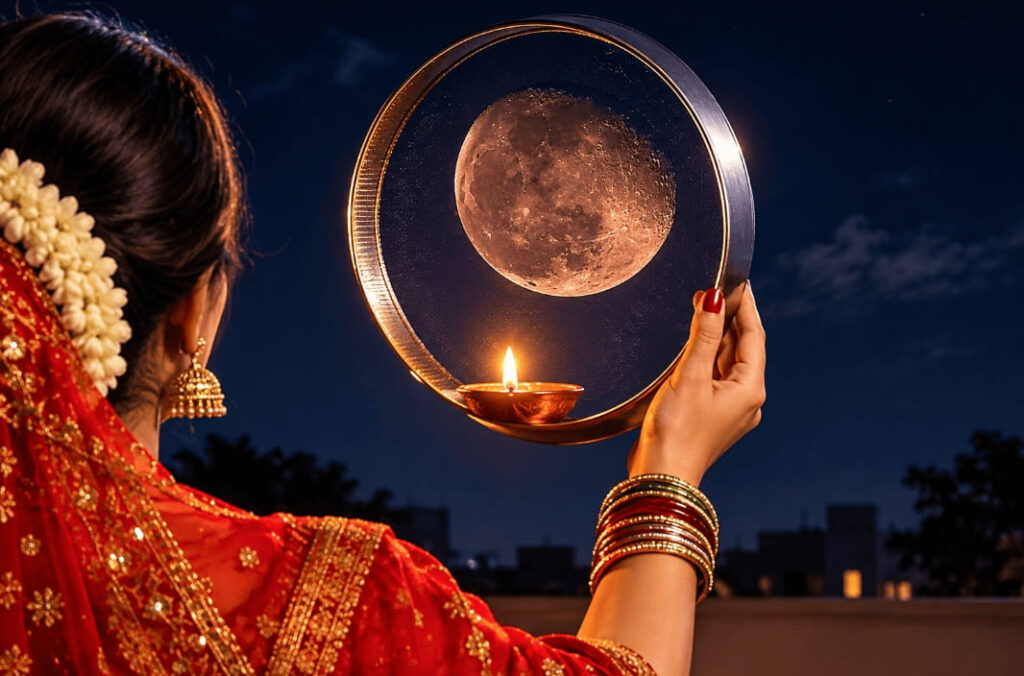
Traditionally, Karwa Chauth is a festival observed by married women in India, who fast from sunrise until moonrise, praying for the longevity and well-being of their husbands. The sighting of the Moon marks the end of the fast, and women offer water to the Moon before breaking their fast.
Thus, the Moon’s appearance is significant to the ritual — both symbolically and astronomically!
This year, Karwa Chauth falls on 29 October 2026.
🌔 The Moon on Karwa Chauth
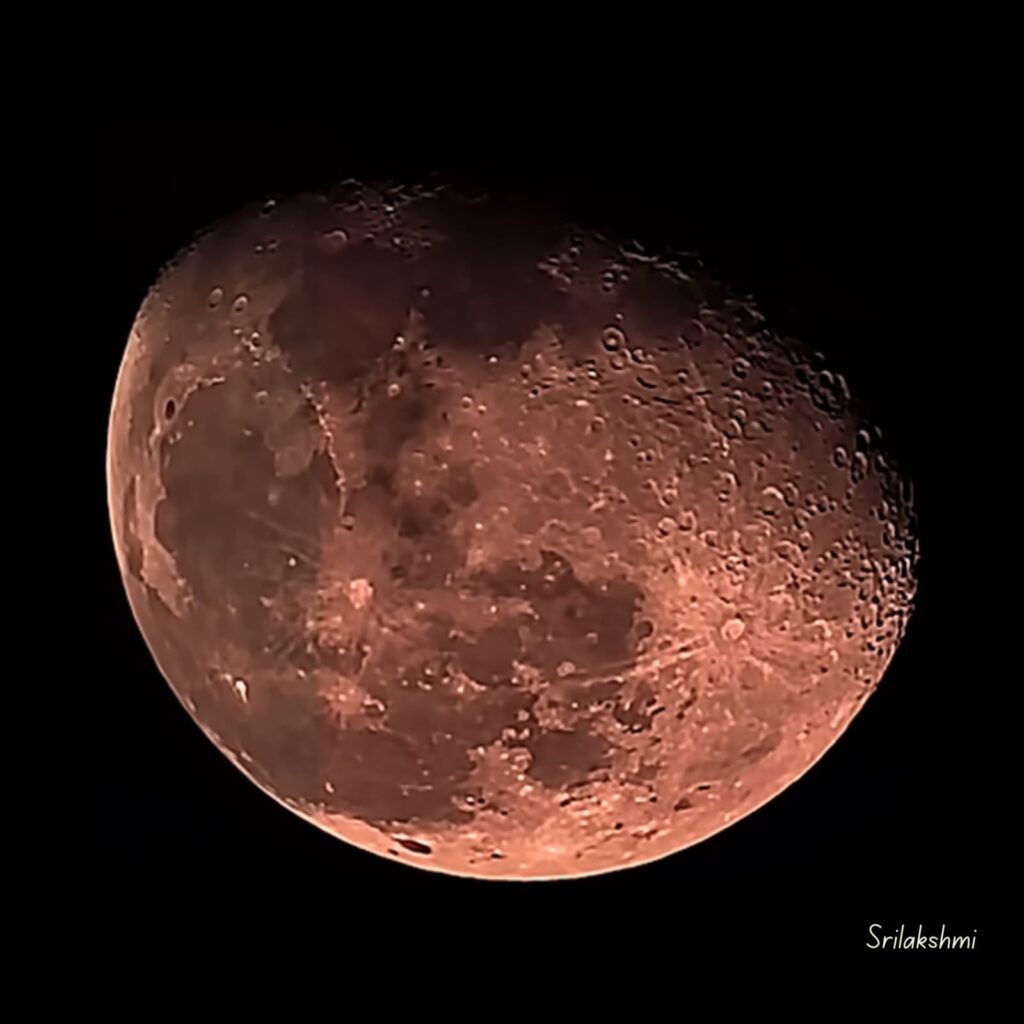
Karwa Chauth falls on Krishna Paksha Chaturthi, the fourth lunar day of the waning fortnight following the full Moon. During this phase, the moon is around 80% illuminated, thereby making it bright but not perfectly round. Historically, such festivals kept people attuned to the lunar cycles – be it for agriculture, timekeeping or other purposes. But in a broader context, these festivals are an example of how ancient traditions perfectly integrated astronomical awareness into daily life, thereby blending science and spirituality.
Unlike the Gregorian calendar, which is primarily solar, the Hindu calendar is lunisolar, taking both the Moon’s phases and the Sun’s annual cycle into account. This is why the dates of many Hindu festivals vary from year to year.
🌙 Why does the Moon rise so late on Karwa Chauth?
One of the most common questions during Karwa Chauth is: Why do we have to wait so long for the Moon to rise?
The answer lies in orbital mechanics!
The moon orbits the Earth in the same direction as Earth’s rotation. As the Moon moves along its orbit, Earth has to rotate a little farther each day before the Moon returns to the same position in our sky. As a result, the Moon rises, on average, about 50 minutes later each day, although the actual delay varies.
On a full Moon night, the Moon generally rises around sunset. But by the day of Karwa Chauth, the Moon has moved farther along its orbit. It now rises several hours after sunset, leaving us waiting for its appearance above the horizon.