I recently conducted an international class on Environment and Health across the Asia Pacific, and on day one, when asked what was the most urgent health problem they faced, many students from different countries said heat. And I totally agree. I live in Madurai, India, just a few degrees north of the equator – it is always hot here. In fact, Madurai is now counted among the hottest cities in the world, regularly recording temperatures that push past what the human body is built to tolerate for long stretches of the day.
The first thing I do when I go home is switch on the air conditioning unit. Ah, the cool breeze on my heated skin… divine. But what a paradox this is. We have created a cozy, temperature-controlled environment our body craves, but is that what we evolved toward? We have never taken the time to think of the adverse effects of the air conditioner on our body and the environment.
A Heat That Isn’t Going Away
This isn’t a passing bad summer. The heat we are experiencing now is unprecedented, and by most projections, it is not going to ease up any time soon. Each year seems to reset the bar for what counts as “hot,” and the trend line only points upward. We are not waiting out a temporary spike – we are adjusting to a new normal, one that will likely define the coming decades rather than a single difficult season.
Two forces make this especially hard to escape, and both are worth understanding in plain terms.
The first is El Niño – a natural, recurring shift in Pacific Ocean temperatures that happens every few years and tends to push global temperatures higher while disrupting normal rainfall patterns. Think of it as the planet’s own thermostat occasionally getting stuck on a higher setting. When an El Niño year lines up with our already-warming climate, the heat doesn’t just add up – it compounds.
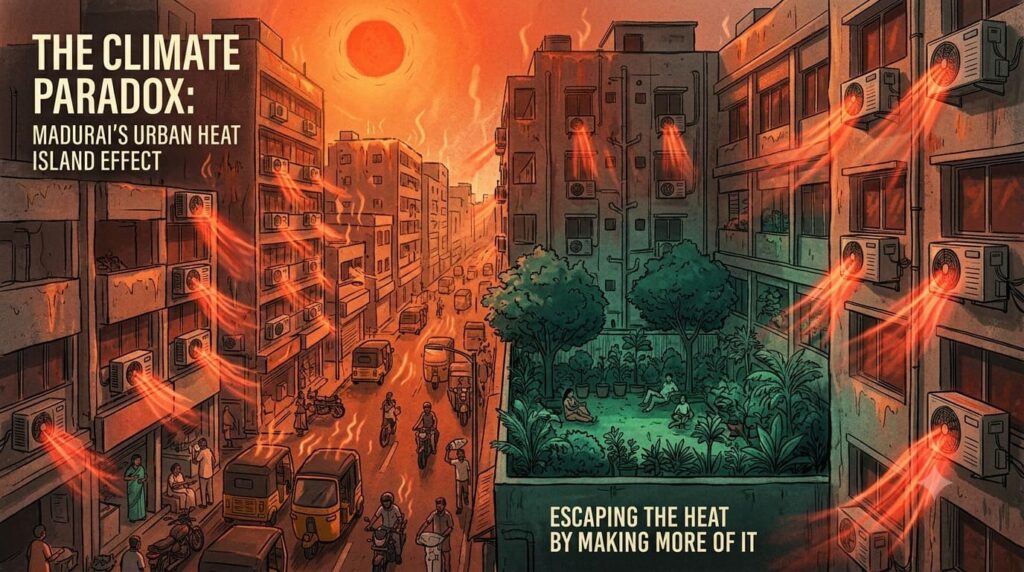
The second is the urban heat island effect, and this one we build with our own hands. Concrete, asphalt, and glass absorb heat all day and release it slowly through the night, while buildings block the breeze that once cooled open land. A city, in effect, becomes its own heater. Step from a shaded village road into the heart of a dense city and you can feel the difference immediately – sometimes several degrees separate the two, with nothing but buildings and traffic in between. Madurai, like most growing Indian cities, is becoming exactly this kind of heat island.
Escaping the Heat by Making More of It
The first thing I do when I go home is switch on the air conditioning unit. And here is the paradox in full: air conditioners don’t destroy heat, they move it. Every unit pulls warm air from inside a room and pumps it, along with the heat generated by the compressor itself, straight out into the street. Multiply that by the millions of units humming across a city like Madurai on any given afternoon, and you start to see it – we are not escaping the heat, we are exporting it. The urban heat island effect described above is partly our own cooling systems working against us in aggregate.
Then there’s the electricity. Most of India’s grid still leans heavily on coal, so every hour of cooling comfort indoors quietly adds to the carbon load pushing outdoor temperatures higher over the years to come. It’s a closed loop with a sting in its tail: heat drives demand for cooling, cooling drives emissions, emissions drive more heat.
There’s a physiological cost too. Constantly retreating into artificially cooled spaces means our bodies lose the chance to acclimatize – the natural process of adapting to heat through sweating efficiency and cardiovascular adjustment. Step outside after hours in 18°C air conditioning into 40°C streets, and the shock is harder on the body than if we’d never left the heat in the first place. We have engineered comfort, but perhaps at the cost of resilience.
One House, Five Units
So here is something worth sitting with: think about how many air conditioners are running in a single house right now – not one, but often three, four, five? One in the bedroom, one in the living room, one in each child’s room, one in the study. A household that once shared the heat of a single ceiling fan across every room now cools each person in their own private climate bubble. We have gone from communal discomfort to individualized, multiplied comfort – and multiplied consumption to match.
Multiply that by every house on the street, every street in the city, every city across a warming subcontinent, and the scale of what we are doing becomes hard to ignore. Each unit is a small, private decision. Together, they are reshaping the climate we all have to live in.
The Question Worth Asking
So, the question isn’t whether to feel the cool breeze after a long, hot day – of course we will. The question is whether we can start asking harder ones: Do all five rooms need their own unit, or could better insulation and airflow serve three of them? Could a shaded courtyard, a green roof, or simply an evening walk after sunset replace an hour of mechanical cooling? Can our building codes and city planning treat heat as a design problem, not just something to be defeated appliance by appliance?
The air conditioner isn’t the villain here – it is a mirror. It shows us, quite literally, the temperature of our choices. My students named heat as the most urgent problem they face, in cities across the Asia Pacific, in countries thousands of kilometers apart. The real paradox isn’t that we’ve built machines to escape the heat. It’s that the more comfortable we make ourselves, the hotter we may be making everyone else.