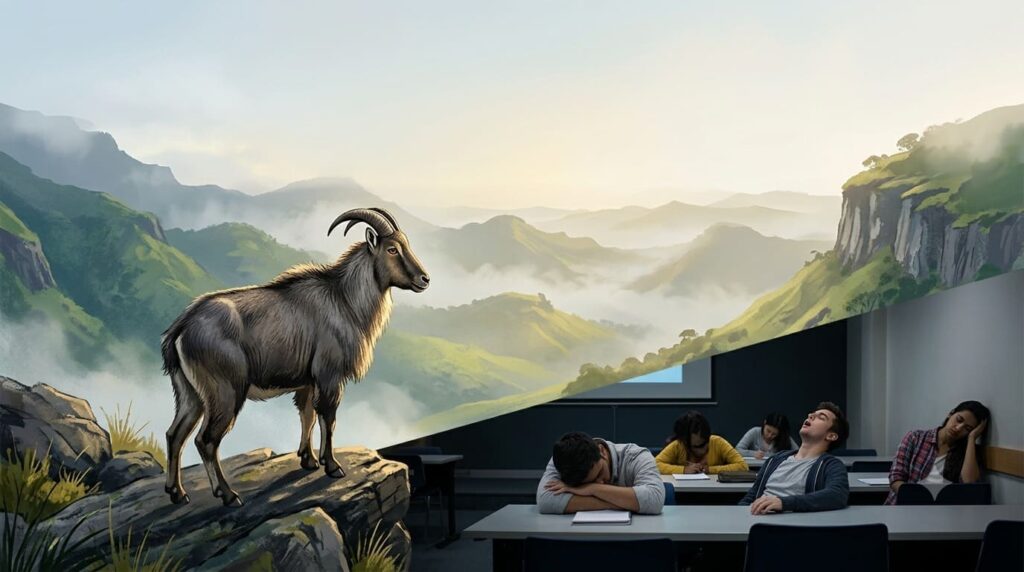
It is Wildlife Week in India, that annual stretch between the 2nd and the 8th of October, bookended by Gandhi Jayanti at one end, when schools, forest departments and conservation groups across the country hold talks, nature walks and awareness drives for seven days. This year’s session on our campus was on the conservation of the Nilgiri Tahr, our state animal, found nowhere else on earth but the Western Ghats of Tamil Nadu and Kerala. I watched, uncomfortably, as several of my own zoology students drifted toward sleep halfway through.
That image has stayed with me far longer than the talk itself. If my students, trained to care about exactly this subject, cannot stay awake for an hour on it, what hope does a single awareness week have against fifty-one weeks of silence?
An Animal Worth Staying Awake For:
Let me first make the case the talk itself should have made. The Nilgiri Tahr is a stocky mountain goat, the only one of its kind in southern India, found exclusively in the high grasslands of the Western Ghats between roughly 1,200 and 2,600 metres. It is old enough to appear in Sangam-era Tamil literature, important enough to be named Tamil Nadu’s state animal, and vulnerable enough to be listed as Endangered, with Schedule I protection under India’s Wildlife Protection Act, the highest level the law offers. Its population once ranged continuously across the entire southern Western Ghats. Today it survives in fragmented pockets, a telling word that shows up again and again in the conservation reports: fragmented, no longer continuous, scattered.
There is, admittedly, a genuinely hopeful thread in this story. The Tamil Nadu government launched Project Nilgiri Tahr in 2022, the state’s first dedicated conservation programme for a single wild mammal, and the most recent synchronised survey this year counted 1,364 individuals in Tamil Nadu, a rise of nearly 5 per cent on the year before. That is not nothing. It is proof that focused, sustained, year-round effort moves the number in the right direction. But it is also proof of how far there still is to go, and how much of that work happens in the 51 weeks nobody is giving a talk about it.
Why One Good Day Can Make Us Worse, Not Better:
Here is what troubles me more than my students’ drowsiness, though. Psychologists have a name for a pattern that may explain exactly what happens after a week like this one ends: moral licensing. The idea, now backed by a growing body of research, is simple and a little uncomfortable. Once we’ve done something that feels morally good, even something small, symbolic or effortless, we unconsciously grant ourselves permission to ease off elsewhere. One field study of a household energy-saving campaign found that the short-term benefit of getting people to change a single behaviour was partly, and sometimes entirely, cancelled out by this exact licensing effect; people who had just done their “good deed” felt freer to slip elsewhere. Other researchers have found the same pattern reaching outward too: when we see someone else perform a visible, one-off act of environmental virtue, we tend to judge their other, less green behaviour more leniently as well, as though the first good act had bought a kind of moral credit to spend later.
Put a week of wildlife talks through that lens, and a grim possibility appears. Attending one session, however earnest, may function less like the start of a habit and more like a ritual act of conscience-clearing: we have now “done” conservation for the year, and can set it down with a clean feeling until the next October rolls around.
The People Who Are Supposed to Carry This:
What unsettles me most, as someone who has spent her career in this field, is watching the erosion show up first in exactly the group meant to be immune to it. As students of zoology, we are, on paper, the people best equipped of anyone to speak for conservation: we have the training, the vocabulary, the access to the data. And yet I see the same fatigue in my own classroom that researchers describe in the general public. A talk on an endangered, endemic animal, one found only in our own backyard, a mountain range many of these students could visit in a weekend, and it struggles to hold the room. If we, who are supposed to carry this forward professionally, are losing interest, I don’t know what story we expect Wildlife Week alone to tell everyone else.
What a Week Can and Cannot Do:
I don’t think the answer is to cancel Wildlife Week, or to stop giving talks on animals like the Nilgiri Tahr. A week of attention is still better than none, and Project Nilgiri Tahr’s rising numbers show what happens when that attention is followed by funded, sustained, unglamorous, year-round work: surveys, radio telemetry, habitat restoration, the kind of labour nobody schedules a talk around because it isn’t dramatic enough to hold a room full of nineteen-year-olds on a Tuesday afternoon.
So perhaps the real purpose of a week like this isn’t the talk itself, but what each of us decides to do with the other fifty-one. Did that one hour change anything about how you’ll live for the rest of the year, or did it simply let you feel, for a week, that you already had?
(Marie Serena McConnell is an Assistant Professor in the Department of Zoology and Research Center at Lady Doak College, Madurai.)