I have been “fat,” or obese, for as long as I can remember. A chubby baby, a chubby toddler, and today, still, obese. You name a diet, I’ve tried it – intermittent fasting, keto, all of it. And it isn’t for lack of activity either. I was far from sedentary. In school I had Bharatanatyam classes every week, I was in the NCC, trekking and camps were simply part of my routine growing up. The only time I was ever truly idle was while reading – I’m a voracious reader, and books are the one place my body got to rest.
“Lose weight” is a phrase that has been harped at me my whole life, as if it were a switch I was simply too lazy to flip. No one seemed to understand that I did try, over and over, and kept losing the battle anyway. My uncle once had me doing 200 stomach crunches a day. I did them faithfully – I lost weight. And then, in no time at all, I put it right back on. Now, well into my late 40s, I’ve gained and lost the same weight so many times over that I’ve genuinely lost count. If you’re reading this and nodding along, I suspect a great many of you have lived some version of this exact cycle.
What the Body Actually Holds On To:
Recent research has finally started to explain why – and sometimes, understanding assuages guilt.
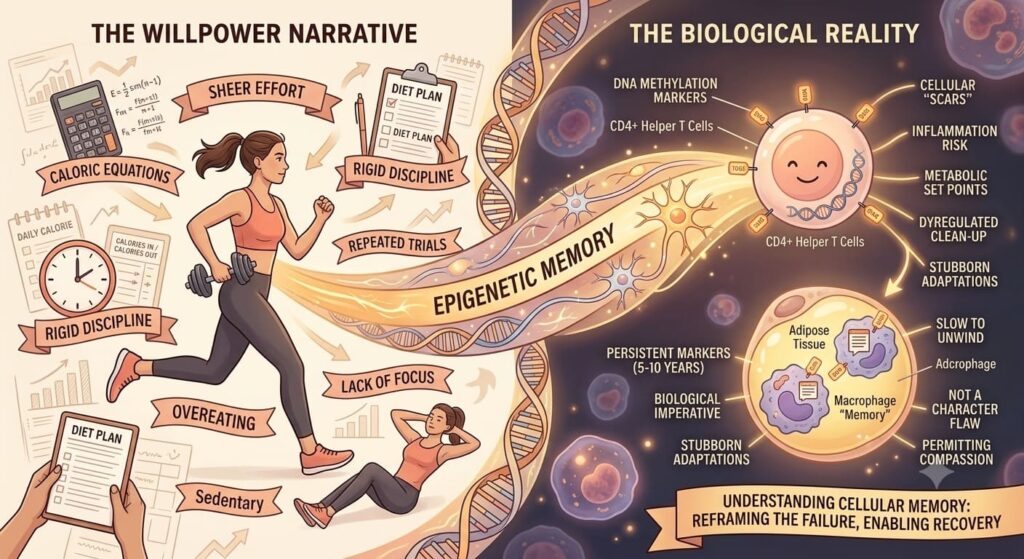
For years, weight regain after weight loss was treated as a story about discipline: people simply drifted back to old habits. But a wave of new studies is showing something far more physical is happening, at the level of the cells themselves. Our bodies, it turns out, don’t just remember being fat in some vague metaphorical sense. They remember it biologically, in ways that actively work against us long after the weight is gone.
One major study published this year followed people over a full decade and found that obesity leaves a lasting mark on a specific kind of immune cell – helper T cells – through a process called DNA methylation, where small chemical tags attach to our DNA and change how genes behave, without altering the genetic code itself. These tags, the researchers found, can persist for five to ten years after a person has successfully lost weight, quietly keeping the immune system in a more inflamed, dysregulated state than it should be – one that raises the ongoing risk of conditions like type 2 diabetes and certain cancers, even in someone who is, by every visible measure, no longer “obese.” The tagging specifically disrupted two things: the cell’s ability to clean out its own waste, and the pace at which immune cells age. In other words, part of what makes the body cling to old set points isn’t a failure of willpower sitting in someone’s head – it’s a molecular scar sitting in someone’s blood.
A second study, this time looking directly at fat tissue itself, found a similar kind of memory in the immune cells that live inside fat – cells called adipose tissue macrophages, whose job is to manage inflammation and clear away dying cells. In mice that were made obese and then guided back down to a lower weight, these macrophages retained permanent changes to how their genetic instructions were being edited, changes that impaired their ability to do their basic housekeeping job. The researchers called this, quite directly, an “obesity memory” – a phrase I found strangely comforting the first time I read it, because it named something I had been feeling in my own body for over forty years without ever having proper words for it.
Why This Isn’t a Free Pass, and Isn’t a Life Sentence Either:
I want to be careful here, because I don’t want this to read as an excuse to stop trying, and it isn’t one. The same researchers are clear that ongoing management after weight loss does, gradually, let this “memory” fade – the tagging isn’t necessarily permanent, just stubbornly slow to undo. What this research actually does is something different and, I think, more valuable: it removes the moral weight from the failure. If you have ever been handed a diet plan, followed it with real discipline, lost the weight, and then watched your body pull you back to where you started – as I have, more times than I can count – this is not proof that you didn’t try hard enough. It is evidence that your immune system and your fat tissue were, quite literally, working from an old memory that your willpower alone was never equipped to overwrite.
A Different Kind of Relief:
I think often about that thirteen-year-old girl doing 200 crunches a day because an adult in her life believed sheer effort should be enough to fix this. She was right to try. She was simply never told that her cells might be holding a memory her muscles couldn’t undo. If there’s one thing I hope you take from this, it’s not a new diet to attempt or a reason to give up on the ones you’re already managing – it’s permission to stop treating your body’s stubbornness as a character flaw. Some of it was never yours to control in the first place.
(Marie Serena McConnell is an Assistant Professor in the Department of Zoology and Research Center at Lady Doak College, Madurai.)