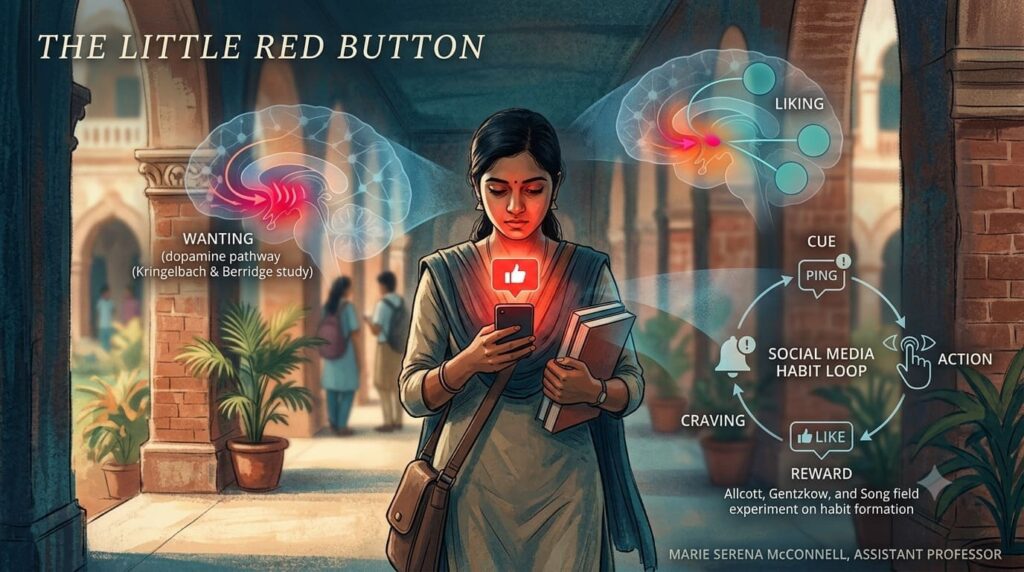
I have spent twenty-four years in the college environment, and in that time I have watched the campus change in ways that have nothing to do with syllabi or buildings. What alarms me today is the small gadget in every hand. Students walk between classes, up and down the staircases, noses buried in the little screen. They do not care who they bump into, or whether they will fall. Even a trip to the restroom involves the phone. When they sit together in the canteen, the phone is still the centre of the table – not for talking, but for photographs, taken again and again, uploaded, and then watched anxiously for the likes that follow.
I have seen what happens when those likes do not come. I once found a girl crying alone in an empty classroom because someone had not liked her picture in a new dress, and had passed some comment about it instead. She was not upset about a dress. She was upset about a number, and a stranger’s opinion, both of which she had allowed to matter far more than they should.
The Chemistry of the Little Red Button
It would be easy to dismiss this as a phase, the way every generation’s habits look excessive to the one before it. But there is real science behind why that number on the screen has such a pull. A 2021 brain-imaging study by Westbrook and colleagues, published in iScience, scanned young adults for their striatal dopamine synthesis capacity and then tracked weeks of their ordinary smartphone use. The proportion of a person’s phone interactions spent on social apps – chatting, posting, scrolling – correlated with lower dopamine synthesis capacity in the putamen, a region tied to motivation and reward. In plainer terms, the people whose baseline reward chemistry ran lower were the ones reaching hardest for the social apps, chasing a hit that their own brains were less equipped to supply on their own.
This dovetails with something Kringelbach and Berridge laid out in their review of the neuroanatomy of pleasure and happiness: the brain’s reward system is not one thing but at least three – wanting, liking, and learning – and they do not always move together. A person can want something intensely, compulsively even, without actually liking it once they have it. That, they argue, is the signature of addiction: wanting untethered from liking. The buzz of a notification, the reflex to check one more time, may have far more to do with wanting than with any pleasure the picture, the message, or the like itself actually delivers.
An Economics of Habit
If the neuroscience explains why the pull feels involuntary, an economics paper by Allcott, Gentzkow, and Song puts a number on how much of our screen time is genuinely a self-control problem rather than a considered choice. Running a large field experiment with paid incentives and optional screen-time limits, they found that people who were simply given the tool to cap their own social media use cut their usage by roughly twenty minutes a day and kept using that limit for months, even though nothing forced them to. Left to a temporary cash incentive instead, use fell sharply while the incentive lasted and then only partly rebounded once it ended – evidence, the authors argue, of genuine habit formation. Their model estimates that self-control problems, amplified by habit, account for close to a third of all the social media use in their sample. People wanted the guardrail. Given one, most of them used it, and kept using it.
Our students have no such guardrail, and neither, if I am honest, do many of us on the faculty side. The pull described in these very different papers – a neuroscience study, a review of pleasure circuitry, an economics field experiment – is the same pull I watch play out on our staircases every single day.
What We Have Become
Our College was once a pioneer of ICT-enabled teaching and learning. We built our reputation on bringing technology into the classroom early and well. Today, some of that same effort has had to turn defensive. We now warn students that they will be fined if caught using phones without a teacher’s supervision or permission. We run one awareness talk after another on cyber-crime and cyber bullying. The UGC itself has now mandated a paper on cyber-crime for all students, a quiet admission from the highest level that this is no longer a fringe problem but a structural one, worth a place in the curriculum alongside everything else we consider essential to learn.
None of this makes me want to take the phone out of anyone’s hand. It has genuine, considerable value, and I would not wish to undo the good it has done for learning, for access, for connection across distances. But value and vulnerability are not opposites; they sit side by side in the same little device. What I would like is for us – students, teachers, parents – to look at the science honestly instead of treating this as a matter of willpower or discipline alone. The girl crying over an unliked photograph did not lack discipline. She was caught, like the rest of us sometimes are, in a loop that was built, quite deliberately, to be very hard to walk away from.
So the question I keep returning to, the one I would ask any student walking past me with their eyes fixed on that small screen, is not whether the phone is good or bad. It is whether we are willing to notice what it is doing to us before it decides that for us – and whether, having noticed, we still have the will, and the awareness, to change it.
(Marie Serena McConnell is an Assistant Professor in the Department of Zoology and Research Center at Lady Doak College, Madurai.)