It is the fag end of a semester here in India, and as I walk along the corridors, I hear students complaining about the burden of studying, the pressure of exams, and everything that comes with them. And I wonder.
The human brain is a remarkable feat of evolution – three pounds of tissue that can compose a symphony, plan a monsoon-season harvest, and recognise a friend’s face in a crowd from fifty metres away. And yet I now hear students complaining, far more often than I ever heard from older generations, of being overworked, tense, and depressed. They can’t multitask. They take a long time to read through and comprehend a problem, let alone spot the obvious answer sitting right in front of them. And the question I keep circling back to, as someone who teaches biology for a living, is this: is this evolution at work? Or is our environment reshaping us all over again?
A Brain That Was Never Built for This
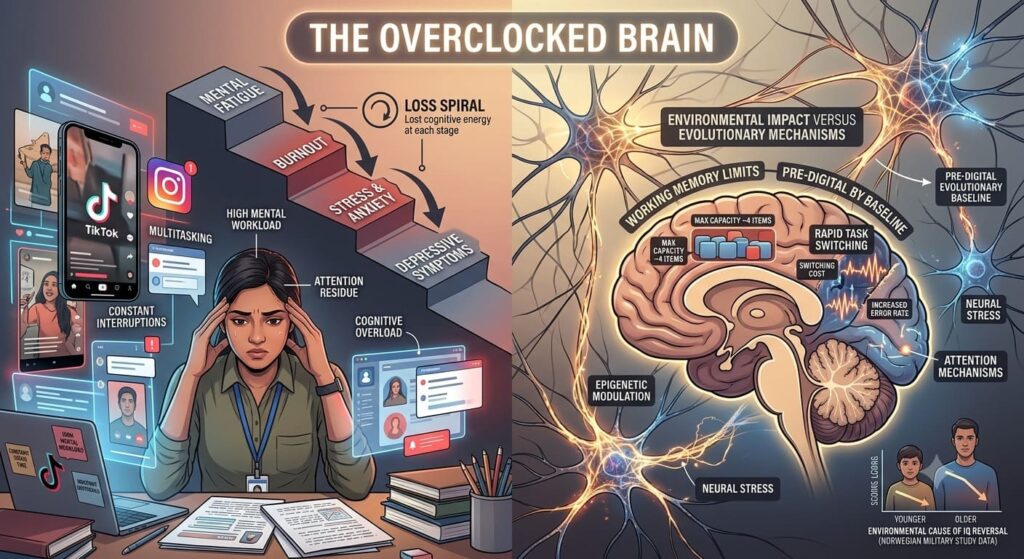
Let me start with the good news for my students: they are not broken. Humans have never truly multitasked. What we call multitasking is rapid switching, and every switch has a cost. Our working memory, the mental workspace where we hold a problem while we solve it, is small, and it was shaped over hundreds of thousands of years for a world in which the day’s biggest stimulus was a rustle in the grass.
Now consider the world we’ve handed it. One study of office workers, published in *Scientific Reports*, recorded mental workload, fatigue, heart rate, skin conductance, and attention over a single working day. The average workload score sat in what the researchers classified as the “high” range. The relationship with performance was not a neat straight line: the authors point to a body of work suggesting that a moderate workload is where the brain does best, while the extremes, too little or too much, are where performance slips. In the second half of the shift, the more fatigued workers were also slower on a divided-attention task, the very thing we now ask of ourselves every time a notification lands in the middle of a sentence.
When Scrolling Becomes a Staircase
Then there’s what we do with our downtime. Oxford University Press named “brain rot” its word of the year for 2024, and it has since moved from internet slang into the research literature. A recent study from Karabük University in Turkey surveyed 439 young adults, more than half of whom spent five hours or more on social media each day, and about a quarter of whom spent seven or more. The researchers measured a kind of cognitive fatigue from endless short-form content, and what they found was not a straight line to depression. Instead, it looked like a staircase: that mental fatigue predicted burnout, burnout predicted higher stress and anxiety, and those, in turn, predicted depressive symptoms. In their framing, depression sits at the bottom of a “loss spiral,” where each lost bit of energy makes the next one easier to lose.
University students describe the same thing in their own words. In a qualitative study of students’ experience of “brain rot,” participants said low-quality digital content hurt their academic performance, left them feeling isolated, and stirred up feelings of inadequacy. Many were already reaching for their own remedies: exercise, digital detoxes, mindfulness.
I want to be careful here, because the science is honest about its limits. The Turkish study was a single snapshot in time, so it cannot prove that scrolling causes the spiral, and it relied on self-reported habits. A larger review pooled 47 studies covering roughly 36,000 adults and found that heavier digital technology use was linked with more psychological distress, anxiety, depression, and stress. Yet the size of the link shrank when the authors corrected for the tendency of journals to publish positive findings, and the same review found that some kinds of digital work, like AI tools and remote working, were associated with less burnout and better wellbeing in the handful of studies available. Technology is not a villain. But it is, at the very least, not neutral.
Are We Getting Less Intelligent?
That brings me to the claim I hear most often: that this is the first generation to score lower on IQ tests than the one before. It is a striking claim, and I’d like to take it seriously without swallowing it whole. It’s more accurate to say that IQ scores rose for most of the twentieth century, by roughly three points per decade, an effect named after the researcher James Flynn, and that in several developed countries, that rise has stalled or reversed among people born from the late 1970s onward. Some commentators in 2026 have gone further and argued that Gen Z may be the first generation in modern history to underperform its predecessors on a wider range of cognitive measures, but that framing is contested, and researchers caution that changing test norms and shifting cultural skills, from gaming to visual processing, complicate any direct comparison.
What makes the evidence hard to dismiss is a study of Norwegian military conscripts by Bratsberg and Rogeberg, published in *PNAS*. They found that scores peaked for men born around 1975 and have declined since, and, crucially, that the decline showed up *within families*. Younger brothers scored lower than their older brothers.
So Is This Evolution?
And that is where my training as a biologist answers the question I began with. Evolution by natural selection works on the scale of many generations: it needs time, heritable variation, and differences in who survives and reproduces. A drop that appears between brothers raised in the same household, sharing the same parents and, on average, the same genes, cannot be the work of natural selection. The authors of that study conclude that both the rise and the reversal of IQ scores were environmentally caused. Nutrition, schooling, smaller families, and fewer childhood infections have all been proposed as drivers of the original rise. What has changed in the environment since is a matter of ongoing research, and no single cause has been established, but rising screen time, less deep reading, and fewer cognitively demanding everyday tasks are among the suspects.
So the honest answer to my students’ struggles, I think, is that evolution is not doing this to them. We are doing it to ourselves, by building an environment that our attention was never designed for and then measuring the brains that grew up inside it.
The Cure We Keep Searching For
Which brings me to the thing that unsettles me most. We overwork and overstimulate our brains all day, and then we go looking for the cure: the digital detox retreat, the meditation app, the productivity system, the supplement, the newest way to “optimise” a mind we’ve just spent eight hours exhausting. Some of these help. The students in that qualitative study found real relief in exercise and mindfulness. But it’s worth asking whether we are treating the symptom while leaving the source untouched. The workload, the notifications, the endless, frictionless feed, all of it stays exactly where it is.
I don’t have a tidy answer, and I don’t think anyone does yet. But I do know this much: if the environment can bend a generation’s scores downward in a single lifetime, then it can also, in principle, be bent back. The question is whether we’re willing to redesign the world our brains live in, or whether we’d rather keep searching for a cure to a condition we keep manufacturing.
(Marie Serena McConnell is an Assistant Professor in the Department of Zoology and Research Center at Lady Doak College, Madurai.)