What if flying began from your neighbourhood instead of a distant airport?
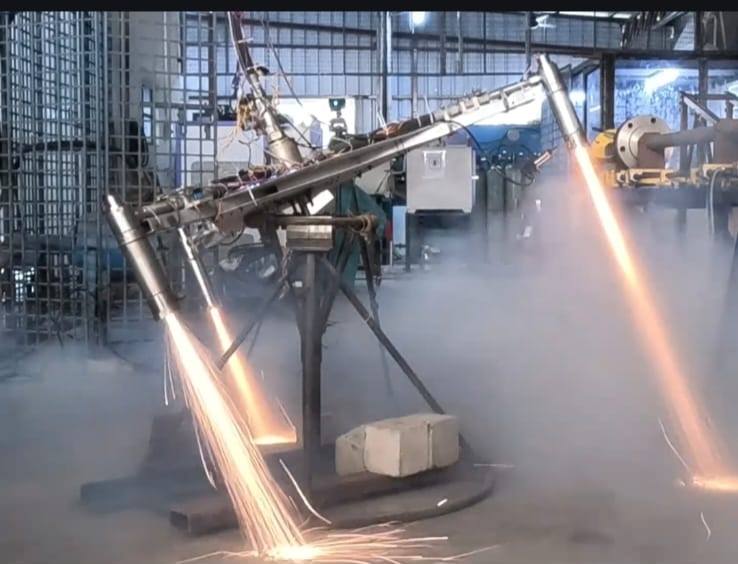
Inside a laboratory at the Indian Institute of Technology Madras, researchers are testing an idea that could redefine how aircraft take off and land. There are no large planes or runways in sight, just a carefully designed experiment combining a real hybrid rocket thruster with a simulated flight environment.
The goal is to develop a system that allows aircraft and unmanned aerial vehicles (UAVs) to take off and land vertically, without the need for long runways. Explaining the significance of the project, P.A. Ramakrishna said, “Vertical take-off and landing, as the name suggests, will enable an aircraft to take off and land vertically, eliminating the need for infrastructure like long runways.”
According to the researchers, such a capability could open up access to remote and rugged terrains where building airports is difficult. “Currently, helicopters are the system operating on those terrains; however, they face limitations in terms of speed, range, and efficiency compared to a fixed-wing aircraft,” Ramakrishna noted.
To test the concept, the team used a method known as hardware-in-the-loop simulation, where a real rocket thruster operates alongside a virtual model of the aircraft. The approach allowed researchers to safely study one of the most critical phases of vertical flight — landing. Researchers say the experiment is unique because it integrated a real, live-firing hybrid rocket motor directly into the simulation loop, providing a highly accurate and cost-effective way to develop and test complex aerospace systems.
The results, they say, have been encouraging. The system achieved a soft landing with a touchdown velocity of just 0.66 metres per second, demonstrating that precise and controlled descent is possible using hybrid rocket propulsion.
Unlike traditional rocket engines, the system is designed to be simpler, safer and capable of adjusting its thrust in real time. Researchers say it could eventually reduce dependence on large airport infrastructure and improve connectivity to regions where building runways is nearly impossible.
Another key innovation is the development of a hybrid rocket fuel system that uses compressed air as the oxidiser, making the technology easier to handle and safer for practical use. The system continuously monitored and adjusted its speed during descent to ensure a smooth landing.
Describing the performance of the technology, Anandu Bhadran said, “The hybrid rocket motor demonstrated the ability to dynamically respond to the thrust demands generated by the control system governed by the guidance algorithm.”
The researchers believe the work marks an important early step towards practical vertical take-off and landing aircraft. As the technology evolves to handle more complex flight conditions, it could move closer to real-world deployment.
Emphasising its long-term potential, Prof. Ramakrishna said, “Once the VTOL system reaches the Technology Readiness Level for commercial application, it will be a game-changer in both civil and military aviation.”
Researchers believe the technology could eventually decentralise air transport by enabling aircraft to operate from multiple locations instead of relying on a handful of large airports, offering strategic and operational advantages for both civilian and defence applications.
While the technology is still at an early stage, the successful demonstration marks a significant step towards developing hybrid rocket-powered VTOL platforms that could one day transform both civilian and military aviation.