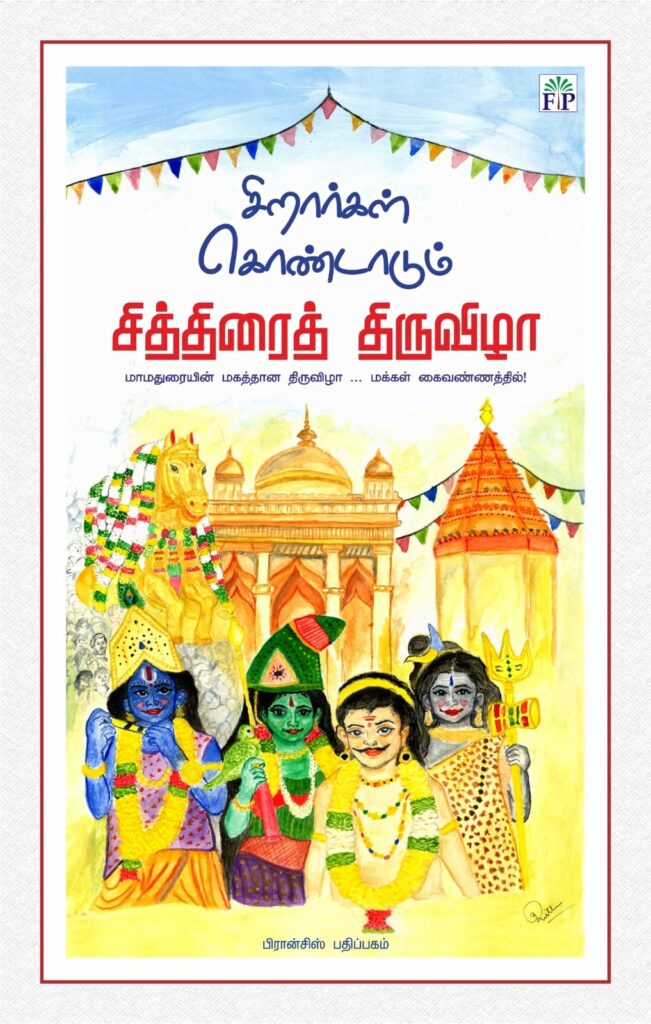
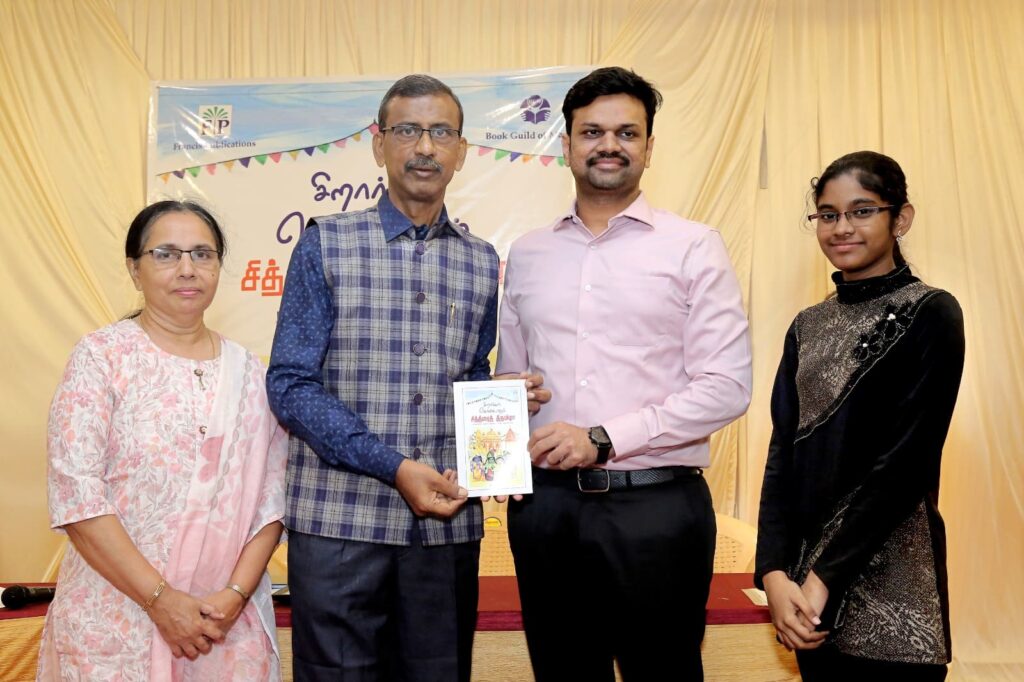
Hundreds of voices saying, “Appa, saami eppo pa varum? Veyil adikudhu” (Father, when will the deity arrive? The sun is scorching), “Ipo vandhurum, nee patharlam” (He will be here soon, you’ll see); the scorching sun, thousands of waiting pairs of eyes, the sound of nadhaswaram and vendors, the smell of malligai poo (jasmine flowers), and little Meenakshi’s, Alagar’s, Karuppan’s and Sokkanadhars everywhere. Kallazhagar descends from Azhagar Kovil and people pour out their prayers. Amidst all this stood Nicholas Francis, camera in hand – not just a devotee, not just a photographer, but a publisher and enthusiast. What emerged from those images, encounters and memories became Sirargal Kondadum Chithirai Thiruvizha (The Chithirai Festival Celebrated by Children).
The book acts as a kaleidoscope to the Chithirai Thiruvizha festival Madurai comes together for, showing its full colours through pictures, poems, essays and a personalised collection of stories. Publisher Nicholas Francis didn’t sit in an office commissioning essays. He walked the streets, stood in the crowds, captured images and the book grew organically from those inspiring photographs. Students, culture and heritage enthusiasts and academicians, including first-time writers, developed the pictures into words out of their experience and memories, taking the reader to the thiruvizha and soaking in it.
The photographs aren’t illustrations of the text; the text is a response to the photographs. The contributors wrote what they saw, felt or remembered when confronted with those images. This makes the book feel less like a curated anthology and more like a collective act of witnessing. Carrying a multi-genre format of poems, essays and stories while keeping the photographs as the centrepiece gives readers room to pause and wonder about the fantasies of the city, the deity and the festival.
The contributors, rather than talking about what the thiruvizha is, talk about what the thiruvizha means to them and bring their thiruvizha to the reader. Colouring their childhood memories back, the wishes, nostalgia, longing and belonging are woven beautifully together.
It is through these personal recollections that the festival emerges as something larger than ritual. The Chithirai Thiruvizha is not merely religious but also an expression of Tamil identity. Heritage, culture, memory and devotion come together as people, beyond their religious identities, gather to meet their Meenakshi Amma and Azhagar.
Most of the pieces in the book are about how parents dress up their children as deities and brim with joy.
Every year, as the April sun blazes over Madurai’s ancient streets and the air fills with the fragrance of jasmine and camphor, a quiet and tender ritual begins in thousands of homes long before the grand processions start. Mothers wake before dawn, drawing their daughters close in the half-light, beginning the sacred transformation that has been passed down through generations. With steady, loving hands, they paint their children’s faces and limbs — பச்சை சாயம் பூசி (their skin painted green), கையில் கிளி வைத்து (a parrot placed in their hand), பச்சை பட்டு உடுத்தி (draped in green silk), அணிகலன்கள் அணிந்து (adorned with jewellery), தலையில் கிரீடம் சூட்டி (and crowned with a tiara) – layering each element with the patience and devotion of a pujari preparing the goddess herself for darshan.
The green dye covers little arms and faces not as costume but as consecration, the silk saree is draped not for play but for prayer, and when the golden crown is finally placed upon a child’s head, the mother steps back with tears she cannot quite explain – not because her daughter looks like Meenakshi Amman, but because in that moment, for just a breath, she is.
On this, C. Saravana Vel writes a heartwarming story that fills us with hope. A Muslim mother married to a Hindu man, struggling with financial debts, has one wish – to dress up her two-year-old daughter for the thiruvizha. In the end, when she kneels down and prays to Meenakshi Amman herself, a transwoman formerly known as Francis and now known as Jebamalar helps her buy the accessories for her daughter and complete the ritual. This piece draws a beautiful bridge between how the people of Madurai love Meenakshi Amma despite their religious differences and how profoundly beautiful humanity can be.
What makes this tradition remarkable is not only its beauty but its continuity – the way it moves, unhurried and unbroken, from one generation to the next. The grandmother who dressed her daughter as Meenakshi forty years ago now watches her granddaughter being dressed the same way, in the same green, with the same small parrot and the same trembling crown. The child may not understand everything she carries, but she understands enough. That understanding is precisely how a culture keeps itself alive.
The stories themselves leave a place in our hearts. A sister confronting the same absence Meenakshi faced when her brother missed her wedding, a transwoman helping fulfil a mother’s dream, a child learning the value of saving and perseverance through the festival – each piece finds its mark. Many of the young debut writers featured in the anthology write with a maturity that readers are likely to remember whenever they encounter the grandeur of Chithirai Thiruvizha again.
The mission of Tamil literary culture is to celebrate, promote and preserve Tamil literature while creating a love for reading, and this book participates in that tradition by turning a living festival into a literary artefact. Festival literature has a long history in Tamil, from Sangam poetry to devotional literature. This anthology builds a bridge between those traditions and contemporary lived experience. Not just today, but years from now, for someone unable to witness the Chithirai Thiruvizha in person, this book will offer a meaningful way to experience it.