


A Signal-Free Traffic System that Could End Urban Congestion for Good
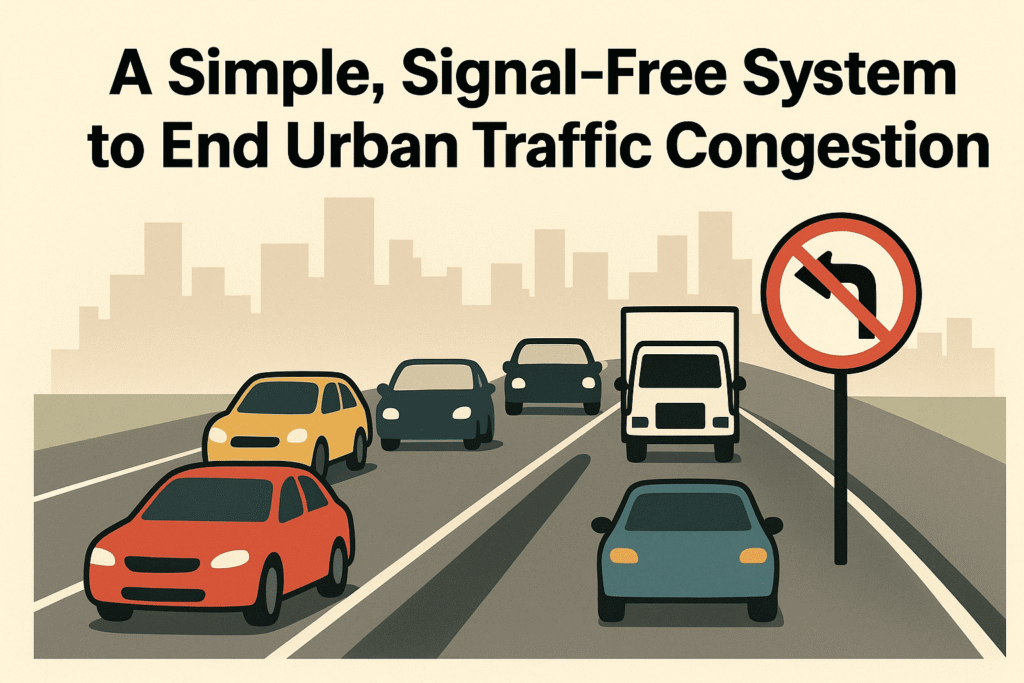
Urban traffic congestion is one of the largest contributors to lost productivity, stress, air pollution, and road accidents in our rapidly expanding cities. Despite deploying sophisticated digital tools, such as AI-based monitoring, smart sensors, and satellite mapping, these technologies can only observe or predict congestion. They cannot prevent it. And for as long as we rely on systems that require power, updates, maintenance, and human intervention, our traffic flow remains vulnerable to breakdowns and interruptions.
What we instead need is a system that works continuously, not dependent upon gadgets or electricity. A model which is simple enough to implement anywhere, strong enough to work 24×7 without fail, and intuitive enough for every driver to adopt naturally. The solution I propose is precisely this: a signal-free traffic flow system built on continuous medians, designated U-turn points, and universal free left turns.
How the System Works:
The base of this infrastructure is a continuous road median, without interruptions other than specifically placed gaps for U-turns. These gaps in the medians are at regular intervals, and most importantly, never across from an intersecting road on the right-hand side. This single rule eliminates right turns altogether. Without right turns, there is also no need for traffic lights anymore.
All left turns become free lefts. All right turns become U-turns. Straight-moving traffic does not stop.
To cross over to the other side of the road or to turn right into a street, a driver first merges towards the median, makes a U-turn at the next available opening, and then turns left into his desired road. Vehicles coming out of side streets just take a free left to join the main road; if they want to go right, they go to the next median break and make a U-turn. The system is self-explanatory and requires no retraining because it is based upon a pattern that drivers instinctively know.
Where a right-side connecting road exists at the point of a median break, a simple V-shaped physical barrier can block illegal right turns, preserving the system’s integrity without technology or signals.
Why This Model Is Effective:
This approach offers immediate and wide-ranging benefits.
Continuous flow of traffic: Since there are no traffic signals, vehicles are never unnecessarily stopped. This minimizes the waiting time and keeps the lanes continuously moving.
Lower pollution and fuel use: Less idling means less fuel burned and feweremissions.
Reduced road accidents: Continuous flow reduces abrupt braking and highimpact collisions common at signal junctions.
No power or equipment required: The system cannot be sabotaged, and it never breaks down because of device failure or due to loss of electricity.
Universally applicable: Works in cities, towns, and rural areas. It is independent of any digital infrastructure development or meteorological conditions.
Self-policed: Drivers instinctively follow the road geometry, requiring less enforcement.
Predictable travel time: With smoother flow, commuters know how long their journey will take.
Economic benefits: Commercial vehicles make more trips in a day, which enhances logistics and, therefore, GDP. Faster deliveries also imply lesser costs of transportation, thus bringing down the final price of a product.
Life-saving advantage: Emergency vehicles such as ambulances never lose precious minutes at a congested signal.
A Sustainable, Scalable Way Forward:
This model proves that in a world increasingly turning to complex technological interventions, the most powerful solutions can be the most simple. A road network designed on free lefts, U-turns, and continuous medians holds the potential to instantly change the face of commuting. It is cost-effective, durable, and virtually maintenance-free. The system can reshape urban mobility, improve economic efficiency, and save countless hours of human time by preventing congestionrather than managing it. It is time to look for practical, sustainable solutions that bring immediate relief to our cities. This signal-free, self-governing traffic design merits serious attention as an answer to our chronic traffic challenges.
Proof on the Road:
Since presenting this proposal, I’ve already seen encouraging signs on Chennai’s roads. Additional U-turns on Airport Road are saving commuters 15–17 minutes, and newly created free-left corridors are working smoothly—clear proof that road geometry, not traffic lights, determines efficiency. Guided U-turns at select points further demonstrate the power of uninterrupted flow.
A section of Mount Road now operates almost entirely on the no-signal model I have championed. Its gaps, however—particularly the lack of adequate U-turn points—highlight a crucial rule: safe lane-change distance must be respected, and right turns must be fully eliminated. Where a road sits to the right of a U-turn, a simple V-shaped median can block that turn and guide drivers naturally into the correct pattern.
The Road Ahead:
My concept is simple but comprehensive. While the core principles never change, each junction requires thoughtful shaping to maintain continuous movement. This is not a one-size-fits-all formula; it is a scalable design philosophy aimed at safety, predictability, and efficiency.
Most importantly, this solution is ready for implementation today. It needs no gadgets, no digital systems, and no retraining—only intelligent road design. Itbrings immediate relief: less waiting, less fuel wasted, fewer collisions, and faster access for ambulances.
At a time when every minute lost to congestion drains our economy and our wellbeing, shifting to a signal-free, U-turn–based traffic system is not just innovative—it is urgently necessary.
A Road System That Works for Everyone
Most of the vehicles we see on our roads belong to private users. When that category is managed better, what remains is public transport and pedestrians — two components that authorities can fully plan, design, and improve. And here’s the key insight: when a system works well for the public, the public naturally follows the rules. Violations disappear not through enforcement, but through convenience. Every violation today is a silent message: “This does not benefit me.” Our mission should be to reach a point where that message is never sent.
Rethinking Our Bus Routes:
Imagine if buses operated without waiting at signals. Buses ply on all roads turning only to their left. When all left turns are free left turns, and no signal to wait and waste time, delays are prevented by default. If a right turn is absolutely required, a wide U-turn space — like the one at Gemini Circle — can be planned. If not feasible, routes can be reorganised so buses continue forward with another service covering the remaining stretch.
This is not just route modification — it’s a reset. It allows us to remove outdated routes that have served their time and introduce smarter paths that meet today’s needs. Faster movement means accurate arrival times and stress-free travel. Why should public transport remain the only system stuck in the past? Let’s upgrade it for a new era. This simplified system of turning left only will greatly support future driverless buses that will take us to a new level of upgrade.
A Smarter Way to Cross:
Addressing pedestrian crossing is the most interesting one. All these days we go to a particular place — intersection or signal — on the road to cross.
Here comes the connection between public transport and people walking. Buses stop exactly at the entrance of all commercial complexes, residential complexes, religious worship places, markets, sports complexes, wedding halls and all places where people gather. Even if it’s a few meters away from each other, buses should stop at every single such point to prevent people from walking on the road. That is the first step.
Bus routes should avoid stopping opposite to such people-centric places to prevent people from crossing. This will cover majority of people crossing the roads. Further, spots to be identified wherever they are prone to crossing where loop shuttles can be provided apart from the existing solutions of escalators, subways, overbridge, skywalks etc.
A Self-Regulating City:
And then, look at what we achieve: a clean flow of vehicles without chaotic junction pressure, buses arriving on time without signal delays, pedestrians walking with confidence not fear, and rules being followed because they make sense. It becomes a system that almost manages itself. Authorities no longer fight chaos — they just oversee order.
This is a dedication
This is for the officers who have tirelessly handled messy, unruly traffic every single day. And to the millions of citizens who deserve safety, ease, and dignity on the roads they use.
This is for all of us.
About the writer:
Mrs. Anuradha Krishnamoorthy is an Advocate (Bar Council of Tamilnadu and Puducherry) and certified Mediator who has long been passionate about improving urban mobility and finding practical, citizen-centric solutions to traffic congestion.
Facebook
Twitter
LinkedIn
Pocket
WhatsApp
Recent stories
Editor's Pick

If I Ever Run Away, It’ll Be Here
April 5, 2026

He Rose… And I Rose With Him
April 3, 2026

Not Mine to Hold
March 29, 2026

The Comfort of Animated Stories
March 29, 2026

More Stories...





Author's Pick

Raven Rhapsody
June 28, 2024

A Fall To Remember.
July 7, 2024

A Feline Legacy: From Kitten to Kindred Spirits
July 13, 2024

Becky’s Wild Days: Gooseberry Raids and Saintly Bites
July 20, 2024

The Animal Whisperer: A Heartwarming Tale of Compassion
July 26, 2024

My Childhood Dream…..An old Age Reality
August 3, 2024

My Slice of Heaven
August 9, 2024

Mustard-Seed Faith
August 17, 2024

Ribbiting Friendship: A Leap of Joy
August 24, 2024
Check our website www.tellmystory.in
Follow our socials for more inspiring stories —
YouTube: https://youtube.com/channel/
Hoote: https://hoote.page.link/
Instagram: www.instagram.com/tellmystory.
Twitter: www.twitter.com/tellmystory__
Facebook: www.facebook.com/tellmystory.
Facebook
Twitter
LinkedIn
Pocket
WhatsApp