Deep inside the forests of Coimbatore’s Madukkarai range, a quiet technological revolution is unfolding along a railway track that was once a deadly crossing for elephants.
Today, artificial intelligence is helping forest officials watch over the movement of the giants, alert trains in real time and give elephants a safer passage across the tracks.
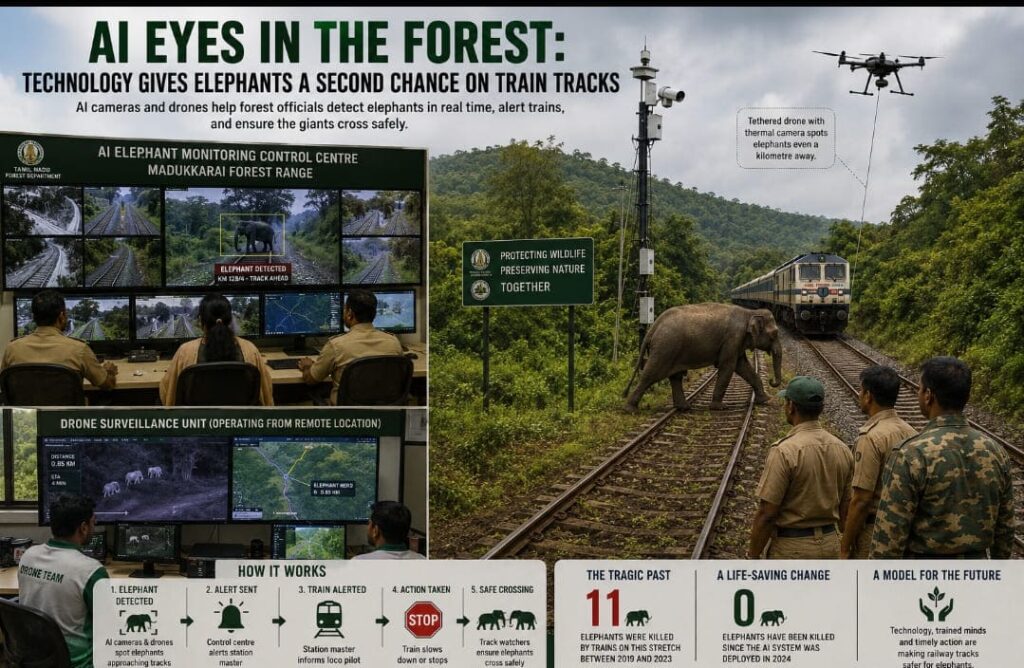
At an AI Control Centre and drone surveillance unit set up along the railway line passing through the reserve forest, forest officials keep a 24×7 watch on live feeds from AI-powered cameras mounted on towers at vulnerable elephant crossings.
The cameras have been trained to recognise elephant movement patterns. When an elephant or a herd approaches the railway tracks, the system generates an alert at the control centre.
Officials then immediately alert the station master, who in turn informs the loco pilot of any approaching train. Depending on the nature and urgency of the alert, the train can be slowed down or brought to a halt.
But the technology does not stop at an alert. Armed with precise information about where the elephants are, track watchers rush to the exact location. Their presence helps ensure that the elephants cross the railway line safely before the train resumes its journey.
There is another layer of surveillance in the skies. Along this stretch, tethered drones equipped with thermal cameras are operated by trained pilots. At the drone control centre, another team monitors the feeds and receives alerts when elephants are detected – even when they are as far as a kilometre away.
The system can also estimate how long a herd could take to reach the railway tracks. That gives forest and railway officials precious time to act, rather than being caught off guard by a fast-moving herd appearing suddenly near the tracks.
The difference is stark. Eleven elephants were killed after being hit by trains on this elephant-crossing stretch in the five years before the new system was deployed.
Since the Tamil Nadu Forest Department introduced the AI-enabled surveillance system in 2024, not a single elephant has died after being hit by a train on this stretch.
For forest officials, it is a remarkable shift – from reacting to elephant movement to anticipating it. For the elephants, it could simply mean the difference between life and death.
Tamil Nadu has already pioneered the use of artificial intelligence in addressing human-wildlife conflict. The Madukkarai experience offers another powerful example of how technology can be adapted creatively for conservation.
AI cannot replace the people working on the ground. But by giving them earlier warnings, more accurate information and precious minutes to respond, it is helping humans and wildlife share a landscape that was once proving deadly for elephants.
What began as a response to tragedy is now emerging as a model worth replicating wherever railway tracks, wildlife corridors and elephant habitats intersect.
(This article was written using AI tools and vetted editorially for accuracy.)